


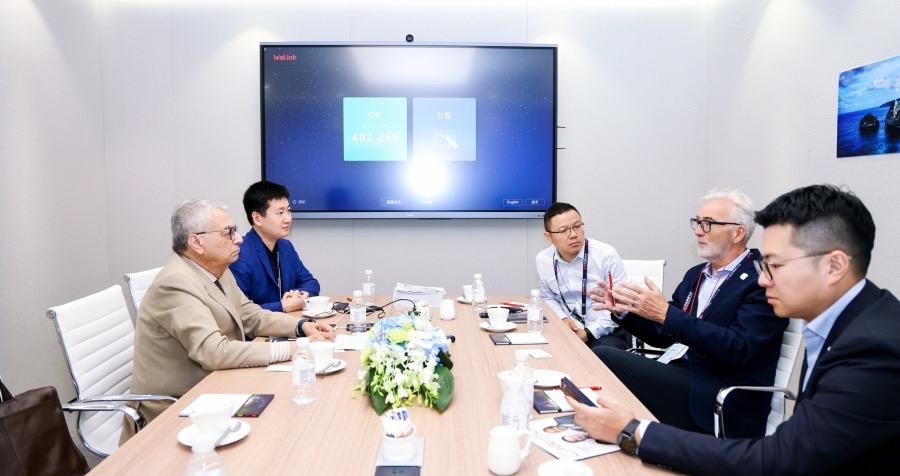
Shaun Collins, Chairman of CCS Insight speaks with Teletimes International in an exclusive interview during MWC Shanghai
Interview: Khalid Athar
Khalid Athar: What impressive developments did you see at MWC Shanghai, especially in the context of MWC Barcelona held earlier this year?
Shaun Collins: That’s a good question. I think there are actually two parts to it: what interesting developments did we see, and how did they differ from what we saw in Barcelona? I’d answer it this way: the overarching themes here in Shanghai mirror those we saw in Barcelona, but they’ve evolved over the last four or five months. What’s emerging is the powerful combination of 5G—especially 5G Advanced—and artificial intelligence. This fusion is proving to be a transformative force, both in terms of network evolution and user experience.
What stood out more here in Shanghai, compared to Barcelona, is the emergence of tangible applications stemming from the integration of 5G and AI. While we saw some of this earlier in the year, the synergy between 5G Advanced and AI is now offering a potent delivery system for real use cases. These range from autonomous driving to industrial automation, including organizational advancements in factories and innovations in the low-altitude economy. Because China has deployed 5G Advanced so extensively, we’re seeing a richer integration of these technologies and more advanced implementations than elsewhere.
“The fusion of 5G Advanced and AI is becoming a transformative force—not just for networks, but for entire industries.”
Khalid: David Wang from Huawei emphasized the rapid progress in the Mobile AI Era, or 5G-A x AI. What do you find most impressive? Do you agree that the growth has exceeded expectations?
Shaun: I’ve been especially impressed by the low-altitude economy deployments here—they’re far ahead of much of the world. The Middle East, particularly around Dubai, the Emirates, and Saudi Arabia, is also progressing well. But compared to Europe, which is trailing, and the U.S., which is moving but not at China’s pace, the developments here are truly striking. The low-altitude economy is particularly noteworthy—it’s caught my attention due to its potential and the scale of growth we’re witnessing.
Khalid: Do you believe the recent growth has surpassed expectations?
Shaun: I’d say yes—but only in certain regions. One of the most fascinating aspects of 5G is that, while the underlying technology is largely the same globally, the speed of development varies significantly and continues to evolve. I was at a Shanghai Mobile event on Tuesday, where they, together with Huawei, launched 5G Advanced 2.0. Meanwhile, there are parts of Europe that still don’t have proper 4G. So yes, the pace of 5G Advanced deployments in China has exceeded my expectations. When I joined the Digital Leaders Program yesterday, many senior leaders from regional operators were present, and there was a general consensus—even from those outside China—that they hadn’t realized how rapidly China was moving forward.
“China’s pace of deployment is staggering—while some regions still struggle with 4G, China is already launching 5G-A 2.0.”
Khalid: What do you think are the possible paths forward for the commercialization and monetization of 5G-A?
Shaun: I see two paths. First, by delivering better throughput and capacity, 5G-A inherently enhances the network experience. But making consumers aware of this improvement is a different challenge.
Shanghai Mobile and Tianjin Mobile, both under China Mobile, are implementing innovative, location-specific tariff programs—such as in subways and stadiums—that add tangible value for users. I find that approach very compelling.
This kind of personalization, along with the network’s ability to deliver targeted services using 5G Advanced and AI, is significant. It enables more intelligent targeting and quicker solution delivery. We’ve talked about this kind of agility for years, but I haven’t seen it implemented this aggressively until now.
Khalid: Why is AI such an important part of the 5G-A conversation?
Shaun: Great question. To succeed with 5G or 5G-A, you need partnerships—technological, public, and private. Whether it’s related to cloud, security, IoT, or AI, collaboration is essential.
Our work has shown us that 5G is a team sport. While it’s possible to go it alone, forming partnerships leads to significantly better outcomes. That could mean working with a football team in Shanghai or partnering with a major cloud provider.
One of the most critical partnerships is between AI and 5G Advanced. When combined, these technologies enhance each other’s effectiveness.
Khalid: Do you think we’ll see 6G within the next few years?
Shaun: Before this event, I’d have said “no chance.” But now, after witnessing the pace of China’s tech market, I can envision a scenario where 6G is commercially deployed in China by 2028.
That said, the rest of the world isn’t ready. Most countries still talk about 6G in the context of a 2030 minimum timeline. This is partly because we’re still defining what 6G actually is—organizations like 3GPP, ETSI, and GSMA are working on that now. But it’s also because the rest of the world hasn’t fully grasped what 5G is capable of yet. China seems to have figured it out faster.
So, a week ago I’d have said no. Today, I’m not so sure.
After being here and actually seeing how 5G and 5G Advanced are functioning—not just hearing about it—I’ve realized how far ahead China really is. In the West, we sometimes let geopolitics cloud our view. But as technologists, our job is to recognize innovation when we see it.
Take devices, for example. Right now, the most interesting innovations—technically, commercially, and aesthetically—are coming from Chinese manufacturers like Huawei, Honor, Oppo, and Vivo. Samsung is finally catching up with products this year that resemble what Honor released in their Magic V2 and V3. China’s pace of innovation and leadership in this space has impressed me more this year than ever before.
Khalid: How should carriers in other regions approach 5G-A and AI? Should they be building these networks and deploying AI too?
Shaun: That’s a tough question. Outside of China—and even outside of the U.S., where 5G is seen as a tool for global leadership—the pace and investment differ significantly.
In Europe, the business case for 5G and 5G-A isn’t as clear as it is in China or the Middle East. The Middle East, like China, is heavily focused on tech leadership and has the capital to pursue it. The U.S. will catch up eventually—but it’s not there yet.
Carriers in other regions should observe and learn from what’s happening in China, Asia, and the Middle East. For consumers, 5G is a harder sell. But for enterprises, the combination of 5G-A and AI is incredibly powerful—it allows them to manage data (“feeds and speeds”) more efficiently, which is what they care about.
Most consumers are fine with 4G or basic 5G. So we need to find alternative ways to engage them. Examples like Shanghai Mobile and Tianjin Mobile show how customized experiences can add value.
Khalid: How do you see the prospects for 5G-A in the Middle East?
Shaun: After China and Asia, the Middle East is the next most significant region for 5G Advanced. The region has both the financial resources and the political and commercial will to become a global tech leader.
“The Middle East has the capital and ambition to lead in 5G-A; its only real challenge is scale, and even that’s manageable.”
The only real limitation is scale. Middle Eastern countries are relatively small compared to China, where scale is a superpower. Just consider this: China Mobile and China Tower reported 1.2 million base stations—deploying tens of thousands annually. Europe, by comparison, might deploy 20,000 in three years.
Despite the smaller scale, the Middle East can absolutely lead. They’ve got the drive and the money—scale is a manageable hurdle.
Khalid: Do you think other regions will eventually catch up?
Shaun: Eventually, yes. But the more relevant question is whether they’ll catch up in time for it to be valuable. In Asia, I believe they will. There’s a drive and confidence there that I don’t see in Europe or the U.S. quite as strongly.
The Middle East is probably only a step behind China and will likely catch up soon. Europe worries me more. The U.S. will follow—it won’t lead, but it won’t lag too far behind either. And yes, I know Americans won’t like hearing that, but it’s where we are technologically today.
Khalid: Is there anything else you’d like to add?
Shaun: I’ve worked in this industry for 35 years, and I love it. But one concern I have is that we’re developing technology without always understanding its purpose. This hasn’t happened on this scale before. Political pressures and public commitments sometimes drive development without a clear plan for implementation. We risk creating more technology than we know how to deploy effectively.
We’re great at innovation, but we need to remember it has to serve a purpose. Right now, we’re often inventing the technology first and then finding the use case. That’s okay to a point—but it complicates profitability, especially in Western markets. Businesses are under pressure to generate returns, and that can make execution harder.
Let’s also be realistic about 5G and AI. As exciting as they are, deploying them—say, for a logistics firm in Berlin—still isn’t cheap. We have to democratize access and offer value without overwhelming costs. Companies like DeepSeek are making strides in that direction.
Finally, partnerships are crucial. Identifying strategic partnerships is one thing. Making them work, especially between large companies unused to collaboration, is another. These relationships take time and effort—but they’re essential to success.
We also must keep sustainability in mind. 5G and AI are power-intensive. Companies like Huawei are making real efforts to mitigate that, and I must say, industry-wide, I’m seeing a strong commitment to environmental responsibility. Sustainability is now a standard part of the conversation, and that’s encouraging.
So yes, the future is bright—but only if we execute wisely, build meaningful partnerships, and maintain our commitment to sustainability.