
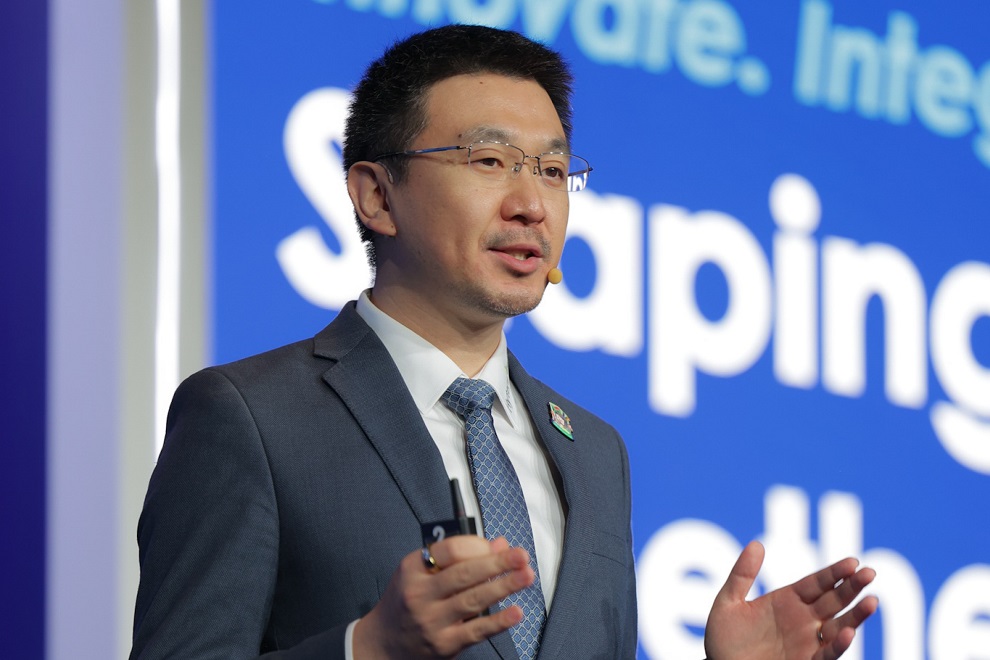

Stanley Song, Vice President of Hytera, speaks to Teletimes during GITEX GLOBAL 2025
For more than three decades, Hytera has stood at the forefront of innovation in professional communications. From its roots in narrowband voice solutions to its current leadership in broadband and AI-driven technologies, the company has consistently focused on one unchanging principle — solving customers’ real-world challenges through secure and efficient communication.
“Technology keeps evolving — 2G, 3G, 4G, 5G, AI — and our customers evolve with it,” says Stanley Song, Vice President of Hytera. “But one thing remains constant: the need for secure and reliable communication. Innovation only matters when it is useful.”
A Legacy of Customer-Driven Innovation
Hytera’s 32-year journey has been defined by continuous evolution rooted in practical customer needs. The company now offers over 200 products, from radios and broadband systems to integrated AI-powered platforms. According to Stanley, Hytera’s strength lies not just in product variety but in its ability to integrate technologies into complete, mission-critical solutions.
This customer-first approach ensures that every innovation — from broadband push-to-talk systems to real-time video analytics — directly enhances users’ operational efficiency and safety.
Leading the Convergence of Broadband and Narrowband
Long before “convergence” became an industry buzzword, Hytera was already pioneering it. “We introduced the concept of broadband and narrowband convergence back in 2017 at CCW Hong Kong,” Stanley recalls.
A prime example is the Abu Dhabi Police project, where Hytera deployed a hybrid TETRA + LTE solution. “For mission-critical voice, they still rely on TETRA’s robust coverage. For data — video, application, multimedia services — they use LTE. It’s the best of both worlds,” Stanley explains. This integration has since become a model replicated across global deployments.
Vertical Integration: Serving Public Safety and Industry
Hytera’s focus has always been professional and vertical — from public safety and transportation to oil & gas and utilities. “Consumer products are not a prime market for us in this region due to due to regulatory and policy constraints,” Stanley notes. “Our customers are governments and critical industries.”
By listening closely to long-time industry partners, Hytera ensures each product is tuned to specific operational needs. Recent collaborations with ADNOC exemplify this philosophy: integrating analog radios, dispatchers, and future broadband systems into a unified platform for enhanced coordination and efficiency.
Sustainability in Practice
Hytera also aligns its manufacturing and operations with global ESG standards. The company maintains an A-level ESG rating in China and adheres to ISO 14001 environmental management standards.
“From solar-powered factories to recycled materials and continuous energy-saving initiatives, we’re reducing our energy consumption by 25 percent compared to previous years,” Stanley shares. “Small innovations every year make a big difference.”
A Global Perspective — and the Middle East Advantage
Operating in over 120 countries, Hytera tailors its solutions to each market’s technological maturity and economic context. In Africa, limited infrastructure drives traditional narrowband systems, while Europe’s mature PMR networks push the shift toward broadband.
But the Middle East stands out. “People here love technology,” Stanley remarks. “They embrace AI, automation, robotics — and they have high expectations from vendors. That’s why we treat the Middle East like a living innovation lab. We co-create solutions with customers and often take these ideas to other markets.”
AI and the Next Leap Forward
Artificial intelligence, Stanley believes, will transform mission-critical communication — but only when applied with purpose. “Technology itself is nothing; the value lies in how it solves problems,” he says.
A striking example is Hytera’s deployment for the Iraqi Ministry of Interior, where the company implemented a nationwide 911 command and control center. The system unified 26 different emergency numbers into one platform, now handling over 150,000 calls daily — far beyond the original 12,000-call projection.
“To handle the surge, we’re introducing AI agents to assist operators to handle calls more efficiently,” Stanley explains. “That’s AI serving a real purpose.”
Despite the high expectations of technologically ambitious regions like the Middle East, Stanley finds the journey inspiring. “It’s challenging, but it’s fun,” he says. “You can always test new ideas here — and that keeps us moving forward.”