
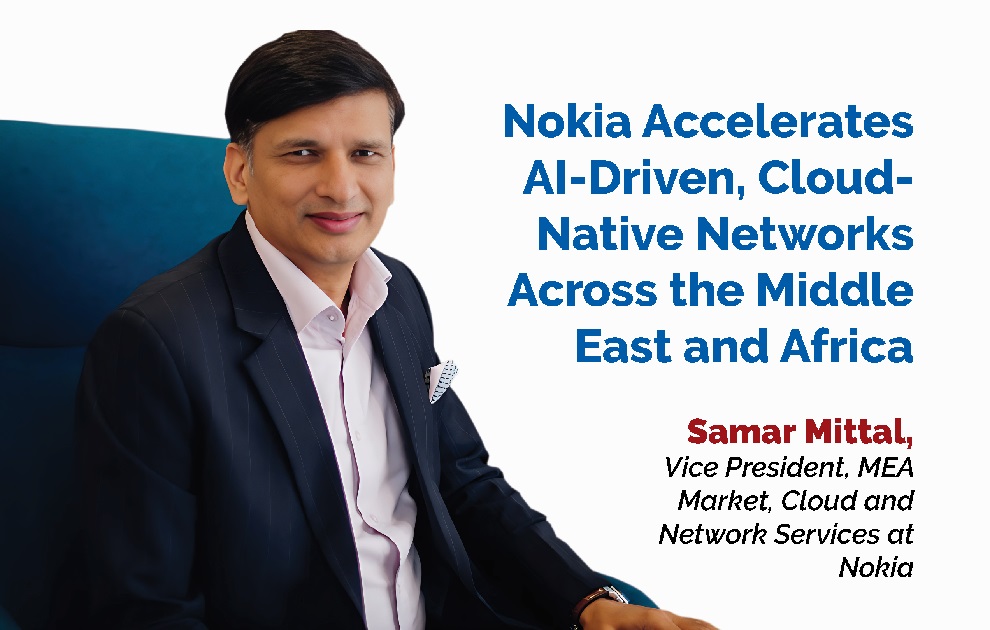

In an era defined by cloud transformation, AI integration, and network automation, Nokia continues to position itself as a global enabler of intelligent, open, and interoperable network ecosystems. At a recent event in the Middle East, Samar Mittal, Vice President, MEA Market, Cloud and Network Services at Nokia, shared exclusive insights with Teletimes on how the company is driving digital evolution across the Middle East and Africa (MEA) region — one of the most dynamic and diverse markets in the world.
“AI, ML, and automation are storming the industry,” says Mittal. “The digital persona, customer expectations, and 5G evolution have all increased network complexity. You now need intelligence built into operations to manage threats, predict failures, and optimise performance in real time.”
One key innovation in this area is Nokia’s Netguard Cybersecurity Dome XDR, a solution designed for AI-based threat detection and pre-emptive response. The company is currently implementing Netguard across several MEA markets, with their biggest reference being Claro in Columbia. Furthermore, their AI-powered orchestration and assurance solution, Digital Operations, has had global success with customers such as T-Mobile USA and Vodafone Qatar as well as won industry awards, like the ‘Autonomous Network Operations Award’ in partnership with stc at the 2025 FutureNet MENA.
“Our approach follows the ‘Sense–Think–Act’ model,” Mittal explains. “We sense the data from the network, apply AI and ML algorithms to think, and then act — automating operations and decision-making while reducing OPEX.”
Building Open, Interoperable Networks
Nokia’s strategy revolves around openness and interoperability, a major shift from the siloed models of the past.
“As an industry, we’ve historically let others build businesses on our networks because we weren’t open,” Mittal says. “Now, our focus is on creating logical blueprints and ecosystems that allow any developer or partner to build directly over telecom networks.”
Through initiatives like Network as Code, Nokia provides Software Development Kits (SDKs) and open APIs — enabling developers to create applications without needing deep telecom expertise.
“Our goal is simple — let developers create new services seamlessly over any network. Every Nokia solution is built for openness, integration, and cross-vendor compatibility.”
Automation in MEA: Leading the Way
According to a recent Nokia/Omdia survey titled Network Automation Trends and Status in Middle East & Africa, MEA operators are 16% ahead of the global average across every network domain in terms of automation maturity. Operators surveyed across nine MEA countries highlighted top drivers such as enhanced customer experience and predictive maintenance, while naming interoperability and security as their toughest hurdles.
“Operators here are more optimistic,” says Mittal. “They can deploy automation faster because many networks are smaller and more agile compared to Europe or the U.S.”
True to that, MEA operators are seeing compelling metrics — Nokia’s data suggest automation can drive 15–20% OPEX optimisation and 20–30% reduction in time-to-market depending on scale and use case.
Business Use Case: Vodafone Qatar Modernisation
A real-world example of Nokia’s strategy in action is its major network modernisation deal with Vodafone Qatar. The agreement covers nationwide roll-out of core network modernization, expanded 5G capacity, enhanced broadband, and built-in automation and security at scale.
“This collaboration reflects the depth of our portfolio and the strength of our partnership with Vodafone Qatar. Through more flexible scaling, reliability, and near zero-touch automation that our advanced core and broadband solutions deliver, Nokia will provide greater network agility and service offerings.” — Raghav Sahgal, President of Cloud and Network Services, Nokia
In Qatar’s rapidly growing digital economy — where the ICT sector is forecast to grow at ~8.5 % annually through 2030 — Vodafone Qatar chose Nokia to lead its transformation.
The modernised infrastructure includes cloud-native multi-access core software (Packet Core, Converged Charging, Network Data Analytics), end-to-end orchestration, 5G network slicing, AI-driven assurance, and a five-year managed services agreement for core operations.
ROI and Financial Perspective
When asked about the return on investment, Mittal is pragmatic.
“It varies by operator and complexity, but typically, the ROI can be achieved within 2.5-5 years,” he says. “The more comprehensive the transformation, the faster the payback.”
Operators with lower ARPU and tighter margins — common across parts of Africa — find automation a necessity rather than an option. Nokia’s survey supports this, showing that MEA operators are leveraging automation not only for cost savings but for service agility and differentiation.
Overcoming the Risks: Technical & Cultural
Mittal identifies three main challenges to autonomous network adoption: investment inertia, infrastructure diversity, and the need for openness.
“In the past, MEA customers were slow to invest,” he says. “But as they see real ROI and the potential of automation, that’s changing. The region still runs 2G and 3G in some areas, while moving toward 5G — it’s a complex mix. Our solutions are designed for this heterogeneity.”
Security and interoperability remain critical barriers. The Nokia automation report found both to be major impediments in local operator strategies.
Partnering with Hyperscalers: Collaboration, Not Competition
Rather than viewing hyperscalers like Amazon Web Services (AWS) as rivals, Nokia sees them as key partners.
“Our strategy is ‘Any Cloud, Any Partner’,” Mittal says. “We collaborate with hyperscalers to create disaster-recovery and redundancy solutions that extend across geographies.”
Nokia’s applications are now certified across major hyperscaler platforms — allowing telecom operators to deploy workloads on data-centres or cloud environments seamlessly.
“We bring deep network knowledge and security expertise that complement hyperscalers’ IT capabilities,” Mittal notes. “Together, we’re enhancing resilience, scalability, and innovation.”
A Cloud-Native Future
Nokia is now fully committed to cloud-native and container-based solutions. The company’s products — from core networks to business applications — are designed for flexibility, scalability and automation.
“Many MEA markets are still on 2G or 3G infrastructure, so leap-frogging directly to containerised networks is easier,” Mittal says. “All our solutions are now cloud-native, and our partnership with Red Hat OpenShift enables full CI/CD integration for continuous updates.”
Emerging Trends: AI Tools, B2B Growth & Defence Tech
Reflecting on the innovations showcased at GITEX, Mittal points to three standout trends:
- AI Tools for Customer Experience: “AI is now practical — it’s helping reduce churn, personalise services, and enhance engagement.”
- B2B Use Cases: “Enterprises are becoming the new growth engines. B2B innovation is reshaping business models.”
- Defence Sector Digitalisation: “Defence solutions are gaining traction, with advanced communication systems becoming vital for national and regional resilience.”
Looking Ahead: Non-Terrestrial Networks & Beyond
Mittal is cautious but optimistic about satellite convergence and non-terrestrial networks (NTN).
“It’s early days,” he admits. “But every new technology creates opportunity. NTN could open new frontiers for connectivity, especially in defence and remote communications.”
He also emphasises that while many operators chase faster speeds, the real value lies in smarter networks that integrate automation, cloud-native architecture, open APIs and sector-specific applications.
Enabling an Open, Intelligent & Secure Future
As the telecommunications industry evolves toward cloud-native, AI-driven ecosystems, Nokia’s vision is clear — build networks that think, act and adapt in real time, while remaining open and secure.
“We’re enabling operators to innovate faster, monetise efficiently, and scale intelligently,” concludes Mittal. “That’s how we define the future of the cloud‐native telco.”