


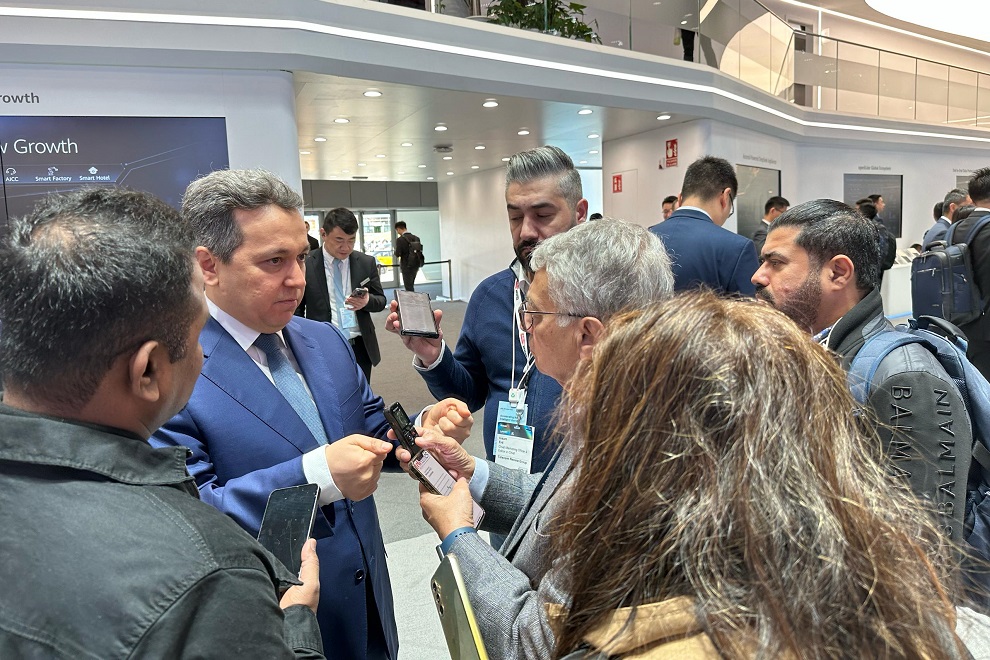
H.E. Sherzod Shermatov, Minister of Digital Technologies of the Republic of Uzbekistan speaks to Dubai Media at MWC 2025 Barcelona
Report: Khalid Athar
| H.E. Sherzod Shermatov is currently serving as the Minister of Digital Technologies at the Ministry of Digital Technologies of the Republic of Uzbekistan. Before assuming this prestigious position, Mr. Sherzod Shermatov held the role of Minister of Public Education in the Republic of Uzbekistan. Additionally, he has an extensive background in the field of innovation and development, having previously worked as the Deputy Minister of Innovative Development. His educational achievements further highlight his expertise in the field. He successfully completed his studies at the renowned Yale University. Moreover, he holds a Bachelor’s degree in Economics from Tashkent State Technical University, further solidifying his understanding and proficiency in this domain. Dating back millennia, Uzbekistan brings a rich history of culture and civilization. As one of the most ancient places still inhabited by humans, the history of Uzbekistan dates back more than 1 million years, according to archaeologists. With Stone Age settlements such as Kulbulak and Obi Rakhmon and productive land, good water sources and abundance of heat that contributed to development of farming, Uzbekistan is rich in every sense of the word. Located at the crossroads of the Silk Road, having more than 7,000 monuments from various civilizations, many of which are on the UNESCO World Heritage List, and a rich history in the world’s major religions such as Zoroastrianism, Buddhism, Judaism, Christianity and Islam, Uzbekistan provides a great destination for tourism. H.E. Sherzod Shermatov, Minister of Digital Technologies of the Republic of Uzbekistan, participated very actively in Mobile World Congress 2025 at Barcelona. Honorable Minister also visited Huawei Technologies pavilion in MWC, during which he had a Media Talk as well. Few Excerpts from his talk are appended below for the interest of Teletimes readers. |
Q: How is the Government of Uzbekistan using technology to improve public services and e-government?
A: Our goal is to make Uzbekistan an IT hub, and this includes advancing digital transformation. The primary aim of digitization is to improve people’s lives by making government services more accessible and corruption-free for citizens and businesses.
We are transitioning government services online, allowing citizens and businesses to access services without visiting government offices. Instead of relying on physical visits or centralized one-stop-shop centers, e-services are now available through mobile phones and PCs. As a result, Uzbekistan has seen significant progress in the UN’s Global e-Government Development Index, moving ahead of 24 other countries. Our goal is to be among the top 30 countries by 2030.
“Uzbekistan has seen significant progress in the UN’s Global e-Government Development Index, moving ahead of 24 other countries”
We are continuously enhancing public services to ensure minimal human interaction. We are also exploring AI-driven solutions to make government services more proactive. Additionally, we have integrated public services with the banking sector, allowing users to access government services directly through their banking apps. This collaboration improves accessibility and efficiency for citizens while enabling banks to better understand their clients’ needs.
Q: Can you elaborate on Uzbekistan’s collaboration with Huawei and other countries like the UAE and Bahrain?
A: Huawei has a long-standing and extensive cooperation with Uzbekistan. This partnership goes beyond merely selling equipment—though Huawei’s technology plays a crucial role in enhancing our infrastructure.
We have connected all schools with broadband, and hospital equipment is also a key focus. However, beyond infrastructure, we are collaborating with Huawei to develop local talent. To achieve this, we are expanding the number of Huawei ICT Academies in our universities and increasing the participation of Uzbek youth in the ‘Huawei Seeds for the Future’ program. Notably, the regional ‘Seeds for the Future’ initiative was held in Uzbekistan for the first time in 2024.
“Huawei has a long-standing and extensive cooperation with Uzbekistan. This partnership goes beyond merely selling equipment—though Huawei’s technology plays a crucial role in enhancing our infrastructure”
Additionally, we are working to establish Uzbekistan as a hub for Huawei’s events and positioning the country as an IT and service outsourcing destination for Huawei’s clients. Our Global Support Center in Tashkent currently serves over 20 other countries from Uzbekistan, creating employment opportunities for 300 Uzbek youth.
Q: How is the ministry cooperating with telecom operators and vendors to modernize the country’s digital infrastructure?
A: As a ministry, we are actively collaborating with all stakeholders. We systematically meet with operators and vendors, reviewing international trends and working to resolve industry challenges. Our focus is on fostering cooperation among operators to drive progress.
As a regulator, we support operators to ensure their growth, and our efforts are yielding positive results. According to Ookla, Uzbekistan’s ranking for mobile internet speed has improved by 65 positions over the past four years.
This progress is a result of our commitment to collaboration, ensuring we listen to operators and vendors while developing innovative solutions. We have achieved this significant improvement—moving ahead of 65 other countries. This success is thanks to our President’s strong political will to transform Uzbekistan into an IT hub.
Uzbekistan is experiencing significant population growth. Job creation remains a top priority, and our President’s vision of making Uzbekistan an IT hub requires several strategic steps. First and foremost, we are expanding network infrastructure by increasing internet access, improving speeds, and reducing costs. Since 2017, the cost of external internet access for operators has decreased by 40 times, making the internet affordable across Uzbekistan.
We are actively inviting IT companies to consider Uzbekistan as an IT outsourcing destination. In 2017, when we began implementing this vision, there were fewer than 10 foreign-capital companies registered as IT Park residents. Now, every month, more than 30 new companies establish offices in Uzbekistan, bringing the total number of foreign-capital ICT firms to over 1,000. These companies are coming because we have honored our commitments, ensuring they receive the best possible treatment in Uzbekistan.
IT companies operating in Uzbekistan benefit from complete tax exemptions, and their employees also pay lower taxes compared to other industries. However, our efforts extend beyond tax incentives—we are also investing in talent development. We have introduced systemic reforms in education, increasing access to preschool education so that early learning investments yield long-term benefits. We have connected all schools with high-speed internet, an uncommon achievement for countries with similar GDP per capita. We are enhancing teachers’ capacity in foreign languages and IT while expanding access to higher education. The enrollment rate in higher education has increased from 9% in 2017 to almost 50% today.
To further promote IT education, we are subsidizing private IT training institutions. Currently, Uzbekistan has over 100 private IT education companies. Additionally, Uzbekistan ranks #1 globally in terms of the share of active learners on Coursera, as highlighted in Coursera’s latest Global Skills Report.
Companies are not only attracted by tax benefits but also by our comprehensive ecosystem. We serve as a one-stop shop, helping businesses establish operations, find skilled specialists, and secure office space. Through continuous communication, we ensure that we meet their evolving needs.

Q: How is the Ministry leveraging AI to build a resilient ICT ecosystem?
A: AI is a hot topic worldwide, but the key challenge is ensuring a strong return on investment. AI is crucial for optimizing capital expenditures (CapEx) in telecom and infrastructure management. Our modern Huawei-built government data center has already reduced IT-related CapEx for state agencies, and we continue to use AI to further optimize spending.
Uzbekistan has developed its own AI-powered Face ID system, My ID, which is the only iBeta-certified system in the region. This technology is widely used in banking and government services. Additionally, AI is being integrated into service delivery, legal document processing, and job creation initiatives. Our focus is to ensure AI supports workforce expansion rather than job elimination.
Q: What steps is Uzbekistan taking to attract foreign investment in ICT?
A: Uzbekistan is becoming a leading destination for IT investment. As I earlier mentioned since 2017, the number of foreign-capital IT companies in our IT Park has grown from fewer than 10 to over 1,000.
Our partnerships with Gulf countries, including Saudi Arabia, the UAE, and Qatar, are strengthening our ICT sector. We are also attracting investments in green energy, with Saudi Arabia’s ACWA Power and the UAE’s Masdar making significant contributions. Our green energy data center, developed in collaboration with DataVolt and ACWA Power, will offer sustainable computing solutions to AI-driven enterprises.
Q: What is your vision for Uzbekistan in the next 5 to 10 years?
A: Our Uzbekistan 2030 strategy focuses on three key goals:
1. Advancing into the top 30 global e-Government rankings.
2. Expanding IT exports to $5 billion annually while creating 300,000 high-paying engineering jobs.
3. Enhancing ICT education, subsidizing training programs, and fostering foreign language proficiency.
Our efforts are already showing results, with Uzbekistan ranking #1 globally in Coursera’s latest Global Skills Report. We are working with the World Bank to promote digital inclusion, ensuring broad participation in the digital economy. Through continuous development and innovation, we are positioning Uzbekistan as a regional leader in ICT and digital transformation.