

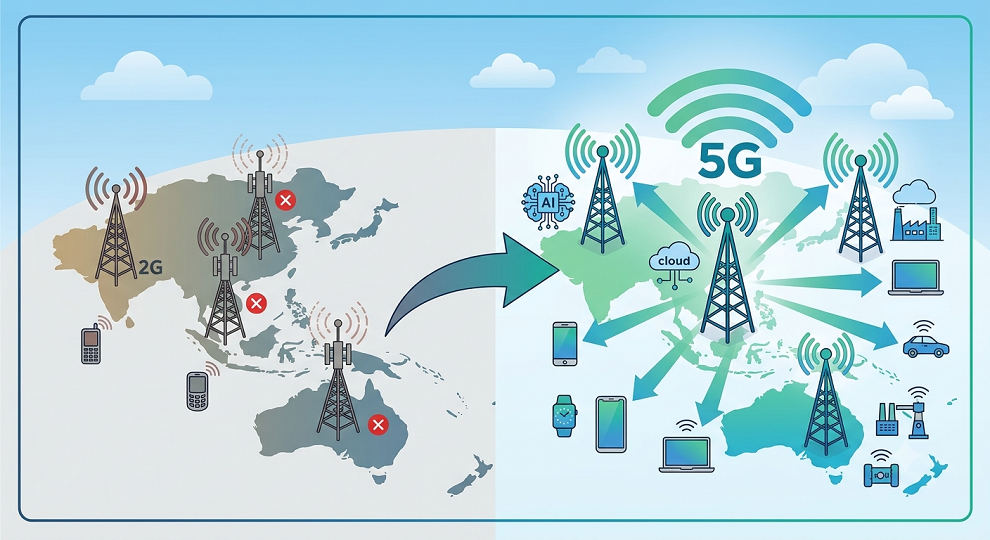

Asia-Pacific’s (APAC) mobile landscape is entering a decisive new phase as operators accelerate the retirement of 2G and 3G networks, freeing spectrum and investment capacity to scale advanced 4G and 5G services. The transition marks more than a technology upgrade; it is reshaping competitive dynamics, enabling AI-driven networks, enterprise innovation, and digital infrastructure that will underpin the region’s next wave of economic growth, says GlobalData, a leading intelligence and productivity platform.
GlobalData’s Asia-Pacific Total Mobile Broadband Forecast (Q1 2026) reveals that the region already had a low 2G and 3G service penetration of about 6% and 2% respectively in 2025, which is expected to decline further to 3% and 0.3%, respectively by 2030, highlighting the decisive shift away from legacy network technologies.
On the other hand, 4G and 5G service penetration reached about 56% and 63%, respectively in 2025, demonstrating how next-generation technologies are becoming a standard across the region.
While 2G networks have already been decommissioned in several countries in the region, 3G network shutdowns are being aggressively carried out by the operators in recent times.
Many regional operators are leading the way:
- India: Bharti Airtel (2020) and Vodafone Idea (2025) shuttered 3G networks, redeploying spectrum and capital into 4G/5G upgrades.
- Australia: Following a 2017 2G sunset, Telstra, Optus, and TPG completed 3G shutdowns in June 2024 to accelerate 5G coverage.
- Singapore: After retiring 2G in 2017, Singtel, M1, and StarHub decommissioned 3G networks in 2024 to fuel 5G expansion.
- Japan and New Zealand: Leading a total 5G shift, New Zealand finalized 3G shutdowns in early 2026, while Japan’s NTT Docomo and Spark NZ will retire 3G by year-end 2026
Kantipudi Pradeepthi, Telecom Analyst at GlobalData, says: “The decommissioning of 2G and 3G networks will allow the mobile service markets in the region to fully benefit from improved connectivity, capacity, and innovation potential of 4G and 5G services. High-speed wireless broadband technologies, especially 5G delivers faster data speeds and low latency, crucial for high-bandwidth applications and advanced technology deployments like IoT and private wireless networks.”
Not surprisingly, operators are now increasingly directing their investments and efforts towards strengthening their 5G networks that can enable advanced digital solutions, ensuring that consumers and enterprises alike benefit from this next wave of mobile evolution.
Singtel partnered with Ericsson in March 2026 to accelerate the development of 5G Advanced into a programmable, AI-led digital platform capable of powering enterprise transformation. In Thailand, AIS launched an AI-driven 5G-Advanced network in May 2026. Bharti Airtel added over 2,900 5G sites across 77 districts in northern India in June 2026.
Furthermore, New Zealand operators 2degrees, One NZ, and Spark finalized their 2026 2G/3G shutdowns, redirecting liberated spectrum into next-gen networks. Regionally, these moves highlight a massive infrastructure pivot, where capital unlocked from legacy retirements directly funds high-yield 5G expansion, network intelligence, and enterprise digital transformation.
Pradeepthi concludes: “As operators complete the transition away from legacy networks, the strategic value extends beyond spectrum efficiency and network modernization. The shift enables operators to support data-intensive applications, expand enterprise service portfolios, and unlock new revenue streams across sectors such as manufacturing, transportation, healthcare, and smart cities. Ultimately, this evolution will play a critical role in strengthening Asia-Pacific’s digital competitiveness and fuelling sustainable economic growth for the long term.”