

Federal IT Minister announces historic milestone as USF Pakistan crosses $1 billion in deployed subsidies; APT Secretary General calls for agile universal service frameworks
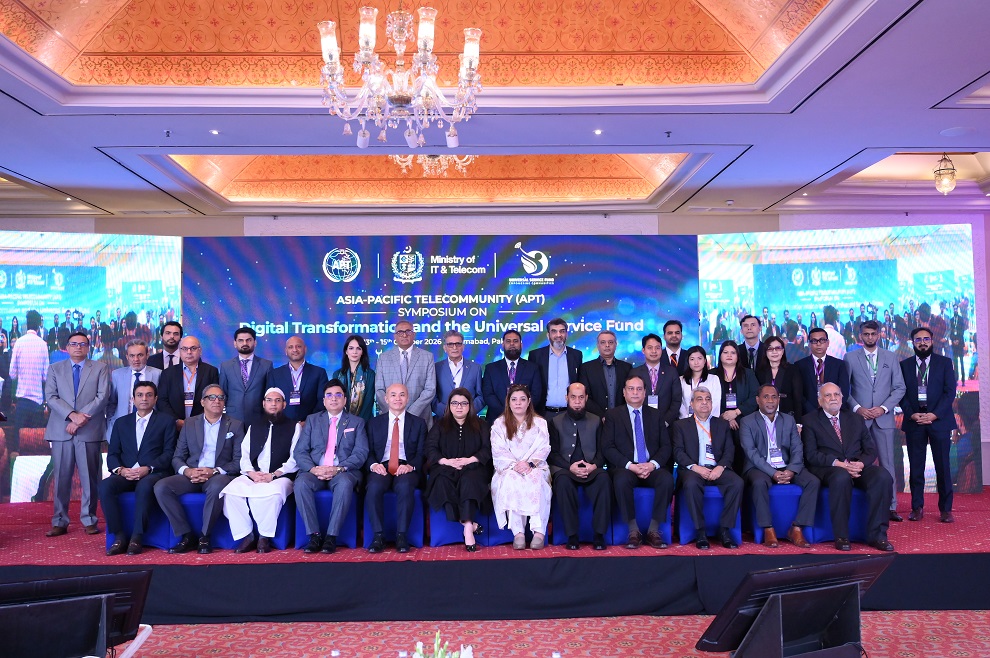
The landmark Asia-Pacific Telecommunity (APT) Symposium on Digital Transformation and Universal Service Fund (USF) opened today in Islamabad. Co-hosted by the Ministry of Information Technology and Telecommunication (MoITT) and USF Pakistan, in collaboration with the APT Secretariat, the high-level international forum brings together ministers, telecom regulators, industry executives, and delegates from across the Asia-Pacific region.
The three-day symposium establishes a forward-looking operational blueprint to modernize universal service mandates across member states—pivoting from traditional coverage and voice subsidies toward gigabit fiberization, non-terrestrial satellite networks, smartphone device financing, and localized rural Artificial Intelligence (AI) infrastructure.
Federal IT Minister announces $1 billion USF milestone
Delivering the Chief Guest inaugural address, Honourable Federal Minister for IT & Telecommunication, Shaza Fatima Khawaja, emphasized Pakistan’s commitment to building an inclusive, secure, and future-proof digital economy, while announcing a monumental achievement for the national telecom sector:
“True digital transformation requires bridging the usage gap just as aggressively as the coverage gap. In driving meaningful connectivity, we treat digital access as an indispensable engine of economic empowerment and social mobility. Under the APT Tokyo Statement 2025 guidelines, Pakistan is modernizing its policy landscape to empower rural communities with high-speed Fiber backhaul, smartphone affordability, and localized AI compute capabilities.”
“I am proud to announce a landmark milestone today: USF Pakistan has officially crossed the threshold of over $1 billion ($1,054 billion) in deployed contracted subsidies, playing a vital, historic role in advancing digital transformation across the country.”
Regional Leadership Calls for Next-Generation USF Models
In his inaugural address, Dr. Masanori Kondo, Secretary General of the Asia-Pacific Telecommunity (APT) said: “Digital transformation is changing our economies and societies—reshaping how governments deliver public services, how businesses operate, and how people learn, work, and communicate. As the Asia-Pacific advances rapidly into the age of 5G, satellite constellations, and artificial intelligence, the risk of digital exclusion has shifted from a lack of physical coverage to a lack of quality, capability, and digital readiness. Universal Service Funds must evolve into agile, outcome-oriented frameworks. Regional cooperation and harmonized regulatory approaches are key to ensuring that no country, island, or remote community is left behind.”
Highlighting the organizational performance and APT Symposium sessions in his welcome address Ch. Mudassar Naveed, Chief Executive Officer, USF Pakistan said that: “For decades, USFs were measured by tower counts in remote regions. Today, meaningful connectivity demands high-speed fiberization, active infrastructure sharing, and demand-side inclusion. USF Pakistan is proud to lead discussions on co-creating Buy-Now-Pay-Later (BNPL) device-financing frameworks, low-cost Right-of-Way (ROW) policies, and resilient middle-mile networks that bridge both economic and geographic divides.
“Aligned with the Prime Minister’s Digital Pakistan Vision and under the guidance of the Honourable Federal Minister, our mission focuses on extending connectivity where commercial viability falls short. To date, we have completed 158 out of 185 awarded projects, utilizing over PKR 169 billion in subsidies and directly benefiting more than 38.4 million people.
The event was attended by a distinguished lineup of senior leadership, international delegates, and telecom pioneers. Prominent attendees included Palwasha Khan, Chairperson, Senate Standing Committee; Sabheen Ghoury, Parliamentary Secretary, MoITT; Rafique Ahmed Buriro, Additional Secretary, MoITT; Masanori Kondo, Secretary-General, APT; and Maj. Gen. (R) Hafeez Ur Rehman, Chairman, PTA.
The regulatory body and the Ministry were further represented by PTA Members Muhammad Naveed and Khawar Siddique Khokhar, along with MoITT Members Asfandyar Khan, Member DET, and Muhammad Jahanzeb Rahim, Member Telecom.
Global delegates included Moshiur Rahman (Bangladesh), Warren Suti (Papua New Guinea), Tshering Dema (Bhutan), Mohd Akmal Radzuan (Malaysia), and Cecily Jemaima Iakopo (Samoa). Industry leadership was strongly featured through Naveed Khalid Butt (PTCL), Shan Ul Haq (PTML), Shahid Razzaq (CMPak/Zong), Ahmed Bilal Masud, deputy CEO of Huawei, and other sector executives.
Building on the Tokyo Statement 2025 and the APT Strategic Plan, the symposium repositions Universal Service Funds as drivers of socio-economic development across four pillars:
1. Accelerating Gigabit Broadband: Expanding Fiber backhaul and last-mile connectivity to unserved and low-income areas.
2. Integrating Emerging Technologies: Leveraging AI, LEO satellites, 5G/6G, cloud, and IoT to bridge the digital divide.
3. Sustainable Funding & Governance: Advancing transparent BNPL device financing streamlined ROW frameworks, and long-term fund sustainability.
4. Multi-Stakeholder Collaboration: Aligning governments, regulators, USF administrators, operators, vendors, and local communities.
Symposium Agenda Overview
• Day 1 (13 October 2026) — Executive Panel & Next-Gen Policy: Executive panel on “Future-Proofing Universal Service for Sustainable Digital Transformation,” featuring leadership from MoITT, NICTA (Papua New Guinea), Jazz, and Nayatel discussing 5G readiness, open-access Fiber, and ROW rationalization.
• Day 2 (14 October 2026) — Infrastructure Extension, Affordability & Governance: Technical sessions covering extreme terrain connectivity, solar-powered green infrastructure, active sharing models, and targeted digital empowerment for women.
• Day 3 (15 October 2026) — Emerging Ecosystems, Disaster Resilience & Strategic Roadmaps: Deliberations on rural AI compute readiness, subsea cable/middle-mile resilience, and early warning systems, concluding with the formal adoption of regional policy recommendations.