
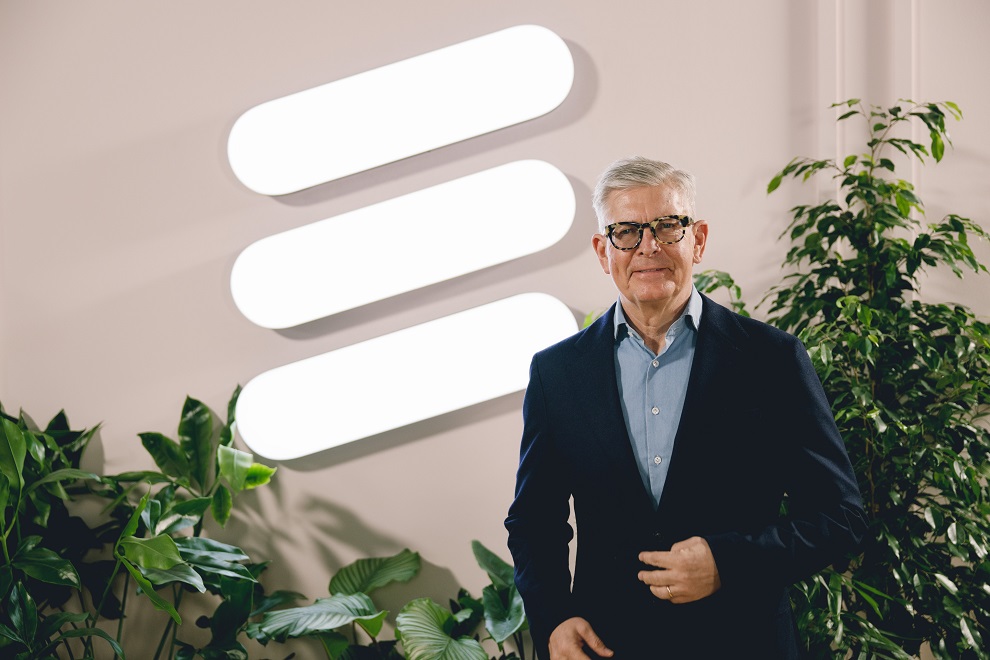

Hyperconnectivity driven by huge numbers of sensors, the expansion of AI into applications and devices, and the role of telecoms in national security was center stage in Barcelona today as Ericsson President and CEO, Börje Ekholm, got the company’s Mobile World Congress (MWC) 2026 program underway.
Ekholm said these three “fundamental forces” shaped this year’s Ericsson MWC event theme – Enter New Horizons – and are central to company demos, seminars, panel and round-table discussions, and customer meetings at the Fira Gran Via venue this week.
He said the AI surge and growth in the number of connected devices will drive high-performance connectivity demand as “everything will be connected.”
“We’re entering a very new era, and it will be done on a 5G Standalone network,” he told Ericsson’s event-launch webcast. “I think that’s really important. 5G has so far been mostly deployed in non-standalone form. But as we now move into 5G Standalone, we can realize the promise of the architecture, the service-based architecture, and the ability to move to the cloud.”
Ekholm said he was excited about the new era, which he said will also put demands on Ericsson.
“We have to make sure that we supply the best networks for AI, to scale AI to enterprises, to public service, and to other mission critical applications,” he said.
Momentum in differentiated connectivity use cases – such as premium fixed wireless access, network slicing, and Network APIs – will also be in focus in Ericsson’s pavilion.
Ericsson’s event space will feature collaborations with more than 120 partners across the industry – comprising more than half of what Ericsson is showing in Barcelona this year.
Ekholm said this was evidence of how the new ecosystem is scaling.
“I think a key going forward is the way we look at the total ecosystem. It’s about actually generating revenues to the whole industry, and the whole digital stack.”
Ekholm referenced the Network APIs-focused joint venture Aduna as an important example of bringing the industry together to form ecosystems to utilize the digital stack.
Ekholm said 5G Standalone would also influence the third ‘fundamental force.’
“We’re starting to see telecom becoming part of national security,” he said. “It’s part, of course, of Mission Critical Networks – but also defense networks.”
Ekholm was joined by special guests during the webcast: AT&T CEO, John Stankey, and Singtel CEO, Yuen Kuan Moon.
Stankey and Ekholm discussed the companies’ December 2023 deal aimed at helping the U.S. communications service provider to move to cloud-based architecture and pursue new revenue streams.
“I think we’ve done a great job of getting the infrastructure set up and in place,” Stankey said. “By the end of this year we’ll have about 70 percent of our traffic on our network flowing over an open architecture.”
Stankey highlighted momentum in fixed wireless access and network slice uptake as being notable and agreed with Ekholm that 5G Standalone is central to the cloud-based and service-based architecture needed for new physical AI services and applications.
Stankey and Ekholm also addressed the importance of collaborating on network security, before discussing the fact that both AT&T and Ericsson celebrate 150-year anniversaries in 2026. While celebrating the landmark they also stressed the need to constantly innovate and think about what is coming next.
Ekholm and Yuen Kuan Moon also discussed the advantages of having 5G Standalone connectivity.
“Standalone was the special ingredient of 5G, but unfortunately the world rolled out a lot of NSA (5G non-standalone) instead of SA (5G Standalone),” Yuen Kuan Moon said. “We were fortunate in Singapore because as a country, we decided that we have to go with SA from day one. So that decision, taken together with the regulator, has actually put Singapore, I would say, ahead of many other countries in terms of the ability to benefit from the SA network.”
He also highlighted dedicated network slices as new revenue generation opportunities across security, factories, airports and seaports, saying offering applications and gaming network slices was also in focus.
“I think we are just scratching the surface here. If we do this well, there’s a lot of opportunity for us,” he added.