
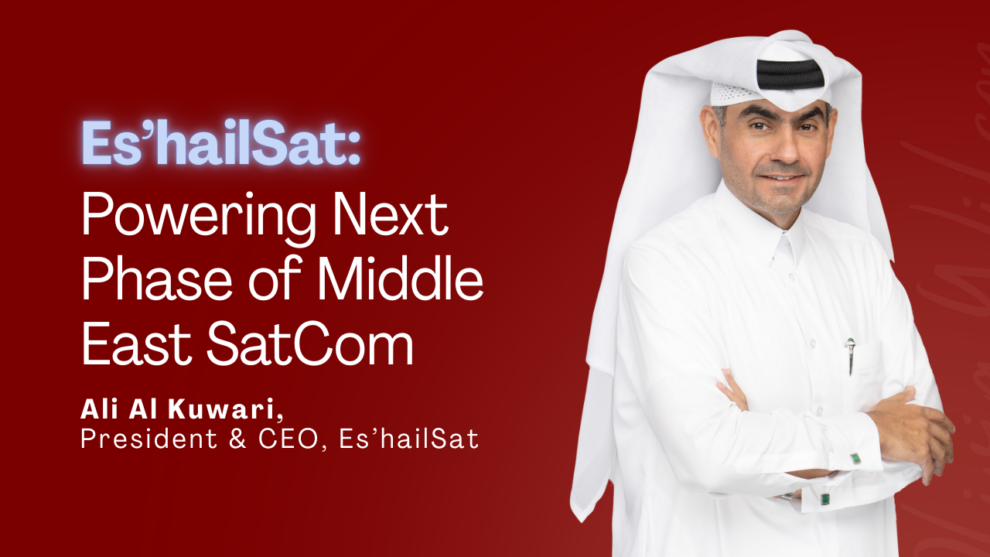

Khalid Athar: Es’hailSat has firmly positioned itself as Qatar’s national satellite operator. How do you envision the company’s strategic direction over the next five years, especially in light of evolving regional and global satellite demand?
Ali Al Kuwari: Over the next five years, Es’hailSat will reinforce its role as Qatar’s sovereign satellite operator while expanding its commercial relevance in the region. Our strategy is anchored on four priorities: (1) Strengthening national communication resilience with next-generation satellite capabilities; (2) Expanding multi-orbit solutions through selective LEO/MEO partnerships; (3) Growing our Teleport and managed-service portfolio; and (4) Developing Qatari technical talent for long-term national capability.
KA: What key market segments will drive Es’hailSat’s growth—broadcast, government, mobility, enterprise, or new digital services?
AK: Government and mobility will remain our strongest growth engines. Broadcast continues to be core and profitable, while new opportunities in enterprise connectivity, cloud access, backhaul, and disaster recovery offer strong commercial potential.
KA: With LEO, MEO, and GEO systems rapidly converging into multi-orbit architectures, how is Es’hailSat preparing to integrate or collaborate within this emerging ecosystem?
AK: Es’hailSat is preparing for a multi-orbit future by evaluating partnerships that enhance Qatar’s communication resilience while maintaining sovereign oversight. Integrating LEO/MEO capabilities will support low-latency applications, mobility services, and cloud connectivity.
KA: How do you see technologies like software-defined satellites, digital payloads, and AI-based network automation reshaping Es’hailSat’s service offerings?
AK: Technologies such as software-defined satellites, digital payloads, and AI-based network automation are paving the way for more flexible, intelligent, and efficient satellite services at Es’hailSat. By embracing these advancements, we can dynamically allocate resources, enhance service customization, and automate network management to better meet our customers’ evolving needs. These innovations allow us to improve operational agility, respond swiftly to market demands, and deliver secure, high-performance connectivity solutions. Ultimately, they help Es’hailSat remain at the forefront of technological progress Classification: General Business in the satellite industry while supporting Qatar’s National Vision 2030 across various pillars.
“Software-defined satellites, digital payloads, and AI-based network automation are allowing us to deliver more flexible, intelligent, and secure satellite services”
KA: Es’hailSat is a preferred broadcast platform for major regional channels. What innovations are you pursuing to support ultra-HD, OTT distribution, and hybrid satellite-IP media workflows?
AK: To support ultra-HD, OTT distribution, and hybrid satellite-IP media workflows, Es’hailSat is investing in advanced satellite technologies and platform enhancements that enable seamless, high-quality content delivery across multiple channels. We are focused on integrating next-generation compression standards and flexible payload architectures to ensure efficient bandwidth utilization and superior video quality for our broadcast partners. Our ongoing efforts include developing robust Tier-4 certified Teleport infrastructure to facilitate smooth transitions between traditional satellite and IP-based media distribution, allowing broadcasters to offer viewers a richer, more interactive experience as well as disaster recovery options. By prioritizing innovation and reliability, Es’hailSat continues to empower regional channels with future-ready solutions that meet the evolving demands of the digital media landscape.
KA: Qatar’s national interests rely heavily on secure and sovereign communications. How does Es’hailSat ensure cybersecurity, resilience, and service availability for governmental and defense customers?
AK: We maintain strict ISO-certified security standards, encrypted networks, 24/7 monitoring, and multi-layered redundancy. Close coordination with national cybersecurity authorities ensures full compliance with Qatar’s defense and security requirements.
KA: Es’hailSat has become an important symbol of Qatar’s ambitions in space. How is the company contributing to space education, national talent development, and Qatari workforce empowerment?
AK: Through partnerships such as our MoU with Qatar University, we support education, internships, and hands-on training. Our goal is to increase national participation in technical roles and build sustainable Qatari capability in the space sector.
KA: How is Es’hailSat incorporating sustainability into satellite operations—whether through ground-station energy efficiency, space-debris mitigation, or greener production and launch planning?
AK: At Es’hailSat, we are committed to incorporating sustainability across all aspects of our satellite operations. This includes investing in energy-efficient Teleport and ground Classification: General Business stations, implementing best practices for space-debris mitigation, and exploring environmentally conscious approaches to satellite production and launch planning. By prioritizing sustainable solutions and continuously evolving our operational strategies, we aim to minimize our environmental footprint while supporting Qatar’s vision for responsible space activities. Our dedication to sustainability not only ensures the long-term viability of our assets but also contributes to the broader goal of safeguarding the space environment for future generations.
“The convergence of multi-orbit networks and AI-driven automation will reshape how the Middle East connects — supporting smart cities, digital transformation, and national resilience”
KA: What trends do you believe will have the greatest impact on satellite communications in the Middle East over the next decade?
AK: Over the next decade, satellite communications in the Middle East will be shaped by the convergence of multi-orbit networks, rapid advancements in software-defined satellites, and the integration of AI-driven automation across satellite operations. Increasing demand for high-capacity, low-latency connectivity will drive innovation, especially in support of digital transformation, remote learning, and smart city initiatives across the region. As regulatory frameworks evolve and partnerships between public and private sectors strengthen, we also expect to see expanded applications in government, defense, and commercial markets. These trends will collectively enhance the region’s resilience, connectivity, and ability to meet diverse communication needs.