


Tom Wilson
The global investment thesis underpinning global artificial intelligence infrastructure remains formidable, yet its financial architecture is confronting severe project-level friction. That operational distinction matters immensely to institutional capital allocators navigating this intermediate transition cycle.
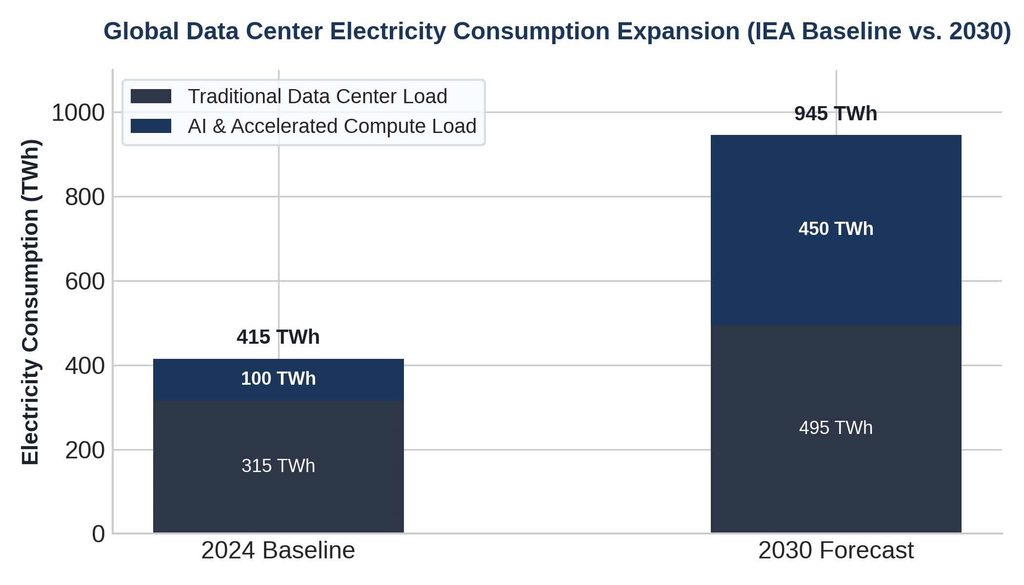
Secular compute demand across global enterprise, sovereign statecraft, and industrial robotics is undeniably authentic. Frontier foundational model training commands massive clusters of accelerated compute over protracted training regimes spanning several months. Sustained inference workloads across autonomous industrial processes, sovereign defense networks, and predictive enterprise pipelines represent an even broader and structurally recurring demand vector. The International Energy Agency projects global data center power consumption will expand from 415 terawatt-hours in 2024 to approximately 945 terawatt-hours by 2030, driven overwhelmingly by high-density accelerated compute deployments across key jurisdictions.
Sovereign wealth authorities, infrastructure funds, and institutional managers continue pursuing gigawatt campuses, generation assets, transmission interconnects, dense dark fiber routes, liquid cooling architectures, and advanced accelerated processing clusters. This deployment wave is not simply an expansion of legacy server facilities, but represents the foundational industrial substrate for synthetic intelligence, state security, sovereign automation, biochemical discovery, and macroeconomic productivity. Yet secular demand elasticity does not automatically validate the aggressive financial leverage currently erected across the capital stack. The critical underwriting dilemma across capital markets is no longer whether advanced artificial intelligence will fundamentally reshape the global economy, as it certainly will. The salient challenge is determining which tranches of the infrastructure stack can sustain leverage amidst elevated capital costs, severe transmission delays, shifting offtaker credit profiles, escalating geopolitical friction, and accelerating hardware obsolescence.
Credit Markets Enforce Selective Discipline Across Key Geographies
Early distress signals are no longer confined to technical benchmarks or GPU capacity reservations. Instead, warning indicators are crystallizing in an extended insurance play very bond performance across global credit derivatives, project debt syndicates, and secondary bond trading desks. Credit default swaps function as liquid, market-clearing pricing mechanisms for default protection on underlying debt obligations. While elevated spreads do not guarantee commercial insolvency, they provide real-time empirical measurements of counterparty distress, execution vulnerability, and leverage saturation.
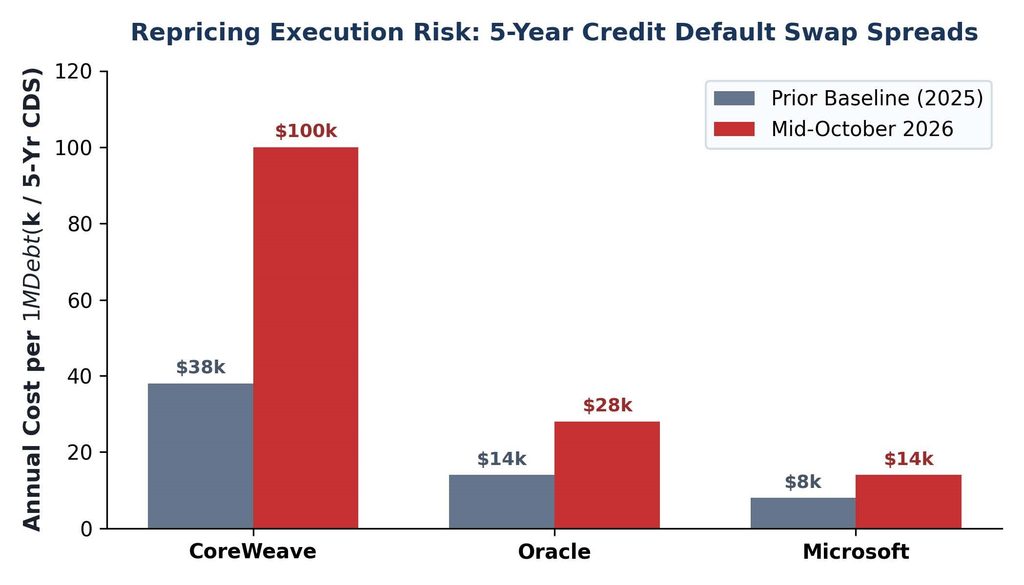
Five-year default protection on CoreWeave debt surged from under forty thousand dollars per million dollars of principal twelve months ago to approximately one hundred thousand dollars in mid-October 2026, pushing debt yields past fifteen percent. Spreads on these instruments moved squarely into territory conventionally associated with acute credit distress. Concurrently, five-year credit default protection on Oracle debt widened to roughly twenty-eight thousand dollars per million dollars of exposure, reflecting underwriting anxiety surrounding multi-gigawatt capital commitments and delayed commissioning timelines. Even Microsoft, commanding one of the strongest balance sheets in corporate credit history, experienced widening spread movement on its credit default obligations. This dynamic does not reflect corporate insolvency risk but demonstrates that secondary credit markets are actively repricing systemic operational and execution friction embedded across the entire global infrastructure deployment cycle.
Doug Ostrover of Blue Owl accurately noted that active derivatives markets exist precisely to hedge lease counterparty non-performance, even against investment-grade hyperscale balance sheets. Hedging mechanisms do not imply inevitable default, but their rising cost erodes commercial margins and compresses debt service coverage ratios across leveraged project vehicles. This structural repricing marks a necessary departure from early euphoria that treated hyperscaler letters of intent and nonbinding backlog announcements as sovereign-rated annuities. Long-dated infrastructure assets require years of disciplined capital deployment before generating unencumbered free cash flow.
Take-or-Pay Commitments Do Not Equal Cash in Hand
Long-term take-or-pay capacity reservations and master service agreements with Tier-1 cloud providers are undeniably valuable. However, institutional credit committees cannot underwrite contractual commitments as unconditional cash flow distributions. The structural fragility of contracted capacity was underscored across the EMEA market when Microsoft terminated its anchor take-or-pay capacity reservation with British cloud provider Nscale. The transaction envisioned twenty-three thousand Nvidia accelerators deployed at a two-billion-pound campus in Essex, yet regional grid constraints deferred upstream high-voltage transmission delivery until the early 2030s. Confronted with a protracted multiyear energization delay, the anchor tenant exercised contractual cancellation mechanisms, leaving an unenergized facility without contracted cash flows and threatening its planned public listing.
Underwriters must therefore dissect offtake documentation with rigorous forensic discipline across six foundational operational inquiries:
-Is the underlying capacity contract fully unconditioned, non-cancellable, and supported by parent guarantees from an investment-grade operating entity? -What specific conditions precedent govern capacity acceptance, commissioning validation, and the mandatory commencement of contracted monthly lease billing? -Which technical milestones govern substation energization, high-voltage interconnection, mechanical cooling readiness, and multi-tenant fiber backhaul delivery? -What specific contractual provisions govern termination for convenience, utility delays, force majeure events, capacity substitution, and cross-border regulatory shifts? -Does the agreement stipulate fixed take-or-pay cash obligations, or does it permit volume variability, tariff indexing, and performance abatement? -Can the special purpose borrowing vehicle service senior amortizing debt if physical commissioning slips twelve to twenty-four months?
Project finance failure rarely stems from an absence of secular compute appetite across enterprise markets. Default risk is driven by temporal sequencing mismatch, where fixed debt service obligations mature ahead of delayed commercial cash receipts.
Refinancing Exposure and the False-Economy Risk
A compounding vulnerability across debt markets is the circular underwriting interdependence linking parallel balance sheets across the ecosystem. One financial institution underwrites a core shell data center based on an emerging operator’s long-term lease. A parallel syndicate finances the GPU fleet through equipment asset-backed loans tied to projected utilization. Credit protection desks write derivative contracts against debt tranches, while senior mezzanine lenders leverage contracted capacity through structured receivables. Perceived system resilience increases artificially even as underlying physical and operational delivery risks become tightly correlated across market participants.
Hedging instruments do not generate physical megawatts of power. Derivatives cannot compress utility interconnection queues, alleviate local planning moratoriums, replace cancelled offtake contracts, or modernize depreciated hardware fleets. Synthetic financial protection merely reallocates defined credit exposure across institutional balance sheets at an expanding spread. When protection pricing escalates, the weighted average cost of capital across the sector moves higher. The principal market vulnerability is not an aggregate collapse in compute consumption. The real hazard is a sharp, selective debt repricing across overleveraged vehicles reliant on single offtakers, congested grid interconnects, or unhedged merchant economics.
Physical Bottlenecks Across NA, EMEA, the GCC, and Asian Corridors
Unconstrained capital deployment has collided with localized physical constraints across key international markets. Financial return hurdles now depend on harmonizing six interdependent pillars: firm generation, physical land, regulatory entitlements, specialized cooling, capital availability, and contracted capacity. Power availability remains the supreme operational constraint across mature metropolitan clusters. In Western Europe, structural grid congestion across traditional hubs like London, Frankfurt, and Amsterdam has triggered severe utility connection moratoria, forcing hyperscale operators to explore alternative geographies.
Grid Operators: UK Power Networks / National Grid, PJM, KSA/UAE Utilities, TNB Malaysia:
–United Kingdom (FLAP-D / London & Essex): 8.0 years average lead time (with queue dates stretching 10+ years into the early 2030s).
–US PJM Interconnection Queue: 5.5 years average lead time (up to 7.0 years for multi-hundredmegawatt substations).
–Southeast Asia (Johor / Batam Corridor): 2.2 years average lead time (up to 3.0 years).
–GCC Sovereign Hubs (Saudi Arabia / UAE): 1.8 years average lead time (compressed utility alignment under 2.5 years).
Conversely, the Gulf Cooperation Council represents a compelling structural counterweight, mobilizing sovereign balance sheets, low-cost domestic energy reserves, and integrated state utility frameworks in Saudi Arabia and the United Arab Emirates to construct gigawatt-scale campuses with compressed interconnection timelines. Simultaneously, Asian infrastructure topologies present distinct operational dynamics across regional submarkets. In Southeast Asia, digital corridors across Malaysia and Indonesia absorb massive hyperscale spillover from land-constrained Singapore, balancing rapid development cycles against local grid modernization demands. In Central and Western Asia, industrial compute campuses are leveraging stranded hydro and thermal baseload assets, while China’s domestic ecosystem advances along independent semiconductor architectures driven by domestic policy mandates and export control constraints.
Local community opposition further dictates deployment velocity across developed and emerging metropolitan jurisdictions. Western European and Asian municipal authorities increasingly resist unmitigated data center development due to escalating water consumption, noise emissions, diesel backup pollution, and residential tariff pressure. Developments lacking integrated power generation, closed-loop liquid cooling, municipal revenue sharing, and local employment generation face protracted litigation and regulatory paralysis.
Geopolitical divergence also fundamentally influences specialized hardware procurement strategies. High-performance processors from Nvidia, high-bandwidth memory components, and advanced optical transceivers remain subject to shifting export restrictions, trade sanctions, and cross-border security compliance. Institutional sponsors must eliminate single-point supply vulnerabilities through diversified procurement agreements and localized power arrangements. Furthermore, physical real estate structures carry thirty-year depreciation schedules, whereas accelerated compute silicon faces economic obsolescence within four to six years. Underwriters cannot leverage physical shells under assumptions that specific semiconductor architectures will sustain premium cash yields indefinitely.
Geographic Bifurcation: Hyperscale Hubs Versus Distributed Edge
Capital deployment is bifurcating between hyper-concentrated utility campuses and distributed inference architectures. The primary segment comprises centralized sovereign campuses exceeding five hundred megawatts, situated near baseload power generation in stable jurisdictions like the GCC, the Nordics, and targeted North American power corridors. These developments rely on integrated energy infrastructure, multi-decade sovereign backing, and creditworthy enterprise consortia capable of underwriting long-duration debt.
The secondary growth vector comprises distributed, modular edge infrastructure positioned adjacent to dense enterprise consumption hubs. Edge deployments process low-latency inference workloads across maritime ports, metropolitan logistics corridors, advanced manufacturing clusters, and regional healthcare centers. Rather than transmitting raw telemetry across congested international backbones, distributed facilities execute localized processing with minimal network transit overhead. This shift is accelerated by efficient open-weight models, exemplified by Meta’s high-parameter architectures executed directly on high-performance localized hardware platforms like Apple’s enterprise silicon. Distributed architectures offer lower power footprints, minimal municipal disruption, and sovereign regulatory compliance, providing institutional credit committees with diversified offtake exposure across creditworthy regional counterparties.
A Disciplined Institutional Underwriting Framework
Institutional capital allocators navigating this intermediate speed hump must enforce rigorous underwriting standards across six distinct execution imperatives:
-Model Contracted Revenues Dynamically: Reject straight-line revenue projections by stress-testing base, delayed, and distressed operational scenarios with at least twelve months of uninterrupted debt service coverage.
-Segment Physical Real Estate from Silicon Risk: Structure physical power assets with low-cost, long-tenor capital, while financing short-lived GPU clusters through rapidly amortizing, high-equity tranches. -Verify Firm Energization: Demand binding utility interconnection agreements, fully funded substation delivery schedules, and dedicated generation assets before validating financial close.
-Stress-Test Tenant Concentration: Evaluate parent-company guarantees, cross-default provisions, and replacement re-tenanting economics across localized cloud providers and emerging specialized neocloud operators.
-Capitalize Contingency Liquidity Reserves: Mandate funded interest reserves, construction contingency facilities, and delay-draw liquidity buffers to insulate debt obligations from external interconnection slippage.
-Harmonize Regulatory and Community Alignment: Invest in closed-loop cooling architectures, waste heat export mechanisms, and grid stability guarantees to maintain essential municipal operating licenses.
Market Prognosis and Strategic Capital Allocation
Three distinct structural outcomes will characterize the next development cycle across global markets: In the optimistic scenario, enterprise inference adoption accelerates rapidly, validating aggressive capital expenditure cycles, absorbing contracted capacity, and rewarding well-capitalized hyperscalers and sovereign infrastructure funds. In the probable base scenario, aggregate demand persists, yet capital selectivity deepens. Fully capitalized platforms with secured high-voltage interconnects, verified sovereign offtake, and conservative loan-to-value metrics capture financing, while speculative, overleveraged projects face restructuring, delayed construction, or asset forfeiture. In the adverse scenario, sustained debt market friction forces widespread recapitalizations. Secondary credit spreads widen further, construction lending contracts, and undercapitalized operators face liquidity shortfalls, transferring modern compute assets to patient sovereign investors at a discounted cost basis.
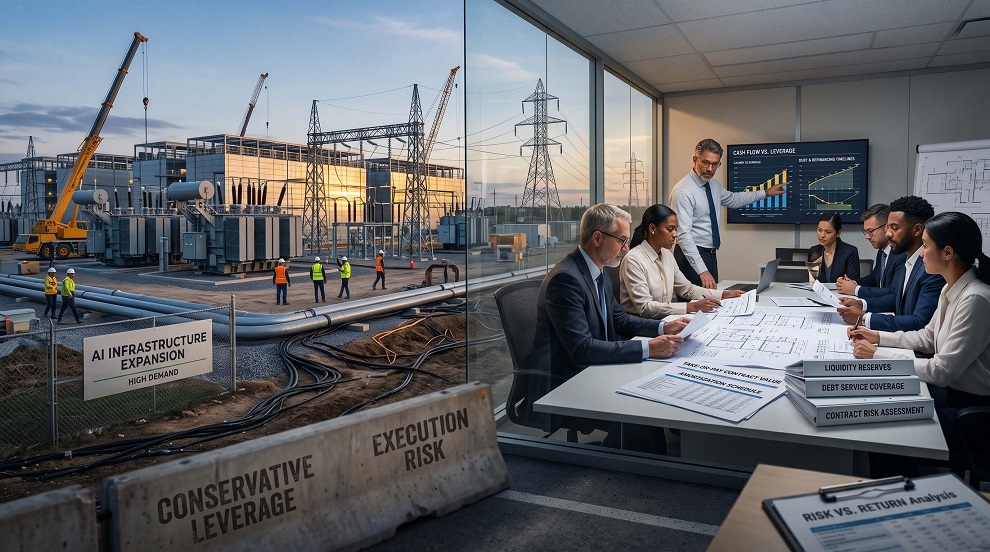
The fundamental inquiry confronting global sponsors is not whether artificial intelligence compute will expand, as it will inevitably expand exponentially across industries. The critical question is determining which infrastructure projects can generate durable, unencumbered operating cash flows across prolonged interconnection delays, capital cost volatility, shifting counterparty credit profiles, and rapid technological turnover. Senior capital allocators must look beyond promotional backlog metrics and underwrite artificial intelligence developments as foundational industrial assets. Conservative leverage, verified electrical energization, robust contractual enforcement, and structural downside liquidity represent the essential prerequisites for sustainable institutional returns.
Institutional References and Market Documentation
International Energy Agency (IEA), ‘Energy Demand from Artificial Intelligence and Data Centers’, Global Energy Outlook 2026.
International Energy Agency (IEA), ‘Electricity 2026: Analysis and Forecast to 2030’, Paris, 2026. The Daily Telegraph & City A.M., ‘Microsoft Terminates Anchor Agreement with Nscale for 23,000-GPU Campus Amid UK Power Network Interconnection Delays’, October 2026.
Semafor Intelligence, ‘The Expanding Cost of Sovereign and Enterprise Default Protection Across AI Infrastructure Debt’,
October 2026. CNBC Global Finance, ‘CoreWeave Credit-Default Swaps Reach Distressed Pricing Levels as Yields Exceed 15 Percent’, October 2026. Axios Macro, ‘Capital Stack Fragility in Leveraged Neocloud and Hyperscale Infrastructure Assets’, October 2026. Brookings Institution, ‘Global Energy Geopolitics, Cross-Border Regulatory Regimes, and the AI Infrastructure Landscape’, 2026.