


With a growing telecommunications sector, longstanding participation across the ITU’s three Sectors and an established record of regional cooperation, Côte d’Ivoire is seeking a seat on the ITU Council for 2027–2030.
The International Telecommunication Union’s Plenipotentiary Conference (PP-26), scheduled for 9–27 November 2026 in Doha, Qatar, will bring Member States together to determine the Union’s leadership and priorities for the coming years. Among its responsibilities will be the election of 48 countries to the ITU Council, including 13 seats allocated to Region D, Africa.
Côte d’Ivoire is contesting one of these seats, drawing on its telecommunications development, previous Council membership and continuing participation in the Union’s technical and development activities. Its candidature comes at a time when countries are working to extend affordable connectivity while responding to growing demands for secure networks, digital services, artificial intelligence and international technical cooperation.
These issues are closely connected. Expanding telecommunications networks creates opportunities for economic participation and service delivery, while the increasing dependence on those networks raises new requirements for investment, reliability, cybersecurity and institutional capacity. Côte d’Ivoire’s experience provides a useful basis for examining how these responsibilities can be addressed nationally and through international cooperation.
Telecommunications Development and Economic Participation
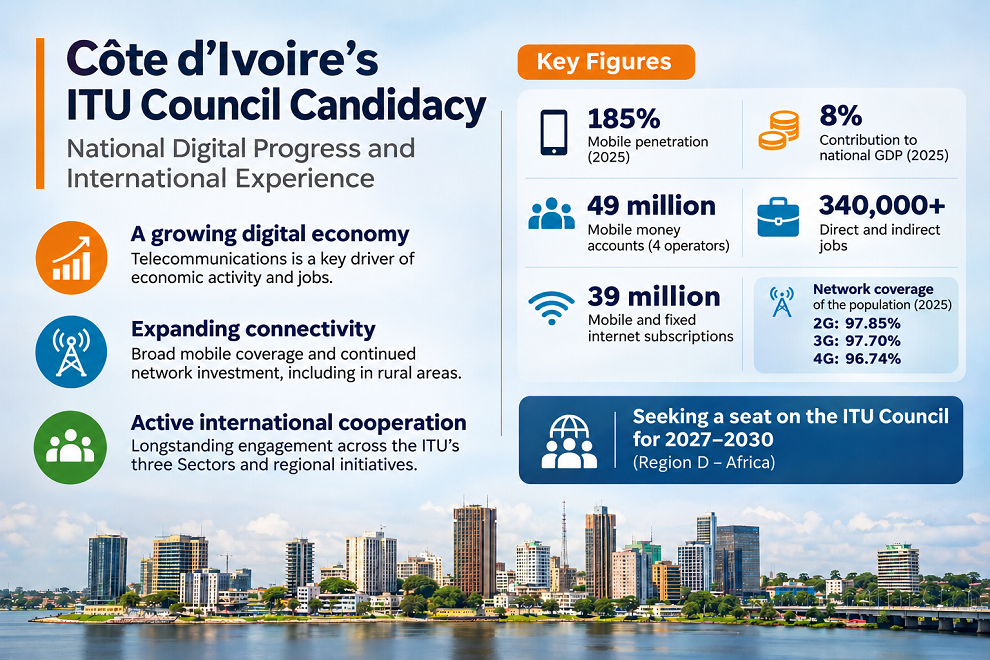
Côte d’Ivoire’s telecommunications sector has become an important contributor to national economic activity, supporting mobile communications, internet access, digital financial services and an expanding range of business applications. According to 2025 figures included in the country’s updated candidature documentation, mobile penetration reached approximately 185%, while mobile money accounts across four operators totaled 49 million. Combined mobile and fixed internet subscriptions reached approximately 39 million.
These figures demonstrate substantial adoption of telecommunications services, although subscriptions do not represent the number of unique individuals connected. Multiple SIM cards and service accounts, together with differences in service usage, remain important when examining the extent of effective digital inclusion.
The sector’s economic contribution is also significant. According to 2025 data, telecommunications contributed approximately 8% of national GDP in 2025 and accounted for more than 340,000 direct and indirect jobs.
The growth of mobile financial services illustrates how telecommunications infrastructure supports economic activity beyond traditional voice and data communications. As more services depend on mobile networks, operators face increasing demand for reliable capacity and service availability, while policymakers must consider investment conditions, affordability and the needs of communities that remain underserved.
For Côte d’Ivoire, these considerations form part of the broader challenge of sustaining telecommunications growth while extending its benefits across the country. Progress in service adoption provides an important foundation, but the distribution and practical use of connectivity remain equally relevant.
Expanding Coverage and Addressing the Remaining Connectivity Gap
Mobile network expansion has brought telecommunications services within reach of much of Côte d’Ivoire’s population. Coverage figures for 2025, attributed to ARTCI in the updated candidature documentation, indicate that 2G networks reached 97.85% of the population, 3G networks reached 97.70%, and 4G networks covered 96.74%.
Geographic coverage remains lower, with reported rates of 89.88% for 2G, 89.39% for 3G and 86.76% for 4G. This difference illustrates a persistent challenge for telecommunications markets, as connecting population centres is generally more commercially viable than extending infrastructure across remote and less densely inhabited territories.
Deployment beyond established population centres often involves higher construction and operating costs, greater dependence on backhaul infrastructure and electricity, and lower potential revenue per site. Addressing these difficulties may require a combination of commercial investment, public programmes and appropriate regulatory arrangements.
Côte d’Ivoire’s National Rural Connectivity Programme (PNCR), encompassing more than 8,500 rural communities according to its candidature material, is intended to improve access in areas that have not benefited equally from network expansion. The programme is relevant to international discussions about universal connectivity because it reflects the practical difficulties of reaching underserved communities.
Network availability, however, is only part of the wider challenge. Affordable devices, suitable tariffs, digital skills and useful services influence whether individuals and businesses can benefit from available infrastructure. These factors also affect the design of universal service policies and telecommunications development programmes.
Côte d’Ivoire Reported 96.74% 4G Population Coverage In 2025, Compared With 86.76% Geographic Coverage. The Difference Illustrates The Continuing Challenge Of Extending Connectivity Beyond Population Centres.
Infrastructure Capacity and the Development of Digital Services
Alongside mobile network expansion, Côte d’Ivoire has strengthened the infrastructure supporting domestic and international communications. Its updated candidature documentation reports approximately 34,752 kilometres of fibre-optic infrastructure across state-owned and private-operator networks.
The country is also connected through six submarine cable systems, with combined capacity reported at approximately 4.8 Tbps. These assets provide a basis for higher-capacity communications, although their economic and operational value depends on how effectively international connectivity is distributed through domestic networks.
Submarine cables provide access to international communications systems, while national fibre infrastructure, mobile networks and interconnection arrangements determine how that capacity reaches enterprises, government institutions and individual users. Reliability, affordability and the ability to maintain services during disruptions are therefore important considerations alongside installed capacity.
Côte d’Ivoire is pursuing additional initiatives intended to support a wider range of digital services. These include a national Tier III data centre under construction at the Information Technology and Biotechnology Village (VITIB), the “City of Innovation and Culture” under construction, and an artificial intelligence laboratory under construction under the PARAE programme in Bingerville.
These projects remain at different stages of implementation, but they reflect the country’s intention to develop capabilities beyond basic telecommunications infrastructure. As businesses and public institutions increase their use of digital applications, the demand for reliable networks, secure data systems and appropriate computing resources is likely to become more important.
The policy framework reflects these requirements. Côte d’Ivoire has identified a National Artificial Intelligence Strategy and a National Data Governance Strategy for 2025–2030, together with a Digital Transformation Strategy extending to 2035. For 2026–2028, seven strategic pillars cover inclusive connectivity, digital public administration, innovation, cybersecurity and digital trust, inclusive artificial intelligence, postal-sector modernization and digital skills.
Together, these priorities indicate the direction of the country’s development agenda. Their implementation will depend on sustained investment, institutional coordination and the ability to translate national strategies into services and capabilities that businesses and citizens can use.
Côte d’Ivoire Reports More Than 34,000 Kilometres Of Fibre Infrastructure And Six Submarine Cable Systems. Its Digital Development Plans Also Address Data Infrastructure, Cybersecurity, Artificial Intelligence And Skills.
A Longstanding Institutional Presence Within the ITU
Côte d’Ivoire’s candidature is also supported by its history of participation in the International Telecommunication Union. An ITU Member State since 1960, the country previously served on the Council during the 1999–2002 and 2019–2022 terms, gaining experience of the Union’s governing processes and the responsibilities exercised between Plenipotentiary Conferences.
Beyond Council membership, its representatives have undertaken responsibilities across the Union’s three principal Sectors: Telecommunication Development (ITU-D), Telecommunication Standardization (ITU-T) and Radiocommunication (ITU-R). This participation is relevant because the Union’s work requires an understanding of technical coordination, international standards and the development needs of countries at different stages of telecommunications advancement.
Within ITU-D, Regina Fleur Assoumou Bessou, Technical Adviser to the Director General of ARTCI, chaired Study Group 1 from 2017 until 2025. She was subsequently elected Chair of the Telecommunication Development Advisory Group (TDAG) at the World Telecommunication Development Conference in November 2025.
TDAG advises the Director of the Telecommunication Development Bureau on the Sector’s priorities, strategies, operations and implementation activities. Its responsibilities involve the relationship between development objectives, institutional planning and the programmes through which the Union supports its Member States.
In the standardization field, Côte d’Ivoire has participated in the work of the Telecommunication Standardization Advisory Group (TSAG) and ITU-T Study Group 3, which examines economic and policy issues relating to international telecommunications and ICTs. For the 2025–2028 study period, Lanciné Fofana of Côte d’Ivoire is listed by the ITU as a Vice-Chair of Study Group 3.
The country’s candidature documentation also identifies vice-chairmanship responsibilities associated with ITU-R Study Groups 4 and 5, concerned respectively with satellite and terrestrial radiocommunication services. In addition, Côte d’Ivoire has participated in expert-group activities associated with the ITU Council.
The significance of these responsibilities becomes clearer when considered together. Extending connectivity into underserved areas, for example, may involve spectrum planning, terrestrial and satellite technologies, technical standards, sustainable investment and development cooperation. Each element falls within a different but related part of the international telecommunications environment.
For an ITU Council member, familiarity with these relationships can inform discussions concerning institutional priorities, coordination and implementation. Côte d’Ivoire’s participation across the three Sectors therefore forms an important part of the documented experience accompanying its candidature.
Côte d’Ivoire Has Served Two Previous Terms On The ITU Council And Has Undertaken Responsibilities Across ITU-D, ITU-T And ITU-R, Including The TDAG Chairmanship In The Current Development Cycle.
Regional Cooperation and International Telecommunications Engagement
Côte d’Ivoire’s institutional involvement also extends to financial contributions and the hosting of regional technical and policy activities. Its updated candidature documentation identifies a contribution of two contributory units to the ITU budget, reflecting its financial participation in the Union’s work.
The country has hosted meetings addressing telecommunications development, standardization, radiocommunications and regional coordination. In September 2026, Abidjan hosted the fourth and final African Preparatory Meeting for PP-26, contributing to the process through which African administrations examined common priorities ahead of the Plenipotentiary Conference.
During the same month, Côte d’Ivoire hosted Africa Space Expo 2026 and the second Radiocommunications Forum, alongside a geographic information systems and data-management workshop associated with the Africa Broadband Maps initiative. Earlier activities included the third and final African Preparatory Meeting for WTDC-25, the 22nd seminar of the Francophone Telecommunications Regulation Network (FRATEL), regional workshops on universal service funding, and meetings involving African regional groups of ITU-T study groups.
These activities address issues with practical implications for telecommunications development. Broadband mapping helps administrations examine infrastructure availability and identify gaps, while universal service discussions consider ways to improve access in underserved areas. Radiocommunications meetings provide opportunities for technical and regulatory exchange, and regional preparatory processes allow governments to coordinate positions before international negotiations.
The importance of hosting these activities lies in facilitating cooperation among administrations and technical institutions facing related challenges. Although the organization of meetings does not by itself establish their outcomes, Côte d’Ivoire’s participation demonstrates continuing engagement with the processes through which regional telecommunications priorities are discussed and developed.
Abidjan’s Hosting Of African Preparations For PP-26, Together With Broadband-Mapping, Radiocommunications And Universal Service Activities, Reflects Côte d’Ivoire’s Role In Regional Telecommunications Cooperation.
Digital Skills, Inclusion and Emerging Technologies
Côte d’Ivoire’s development agenda recognizes that infrastructure investment must be accompanied by the skills and institutional capabilities needed to use digital technologies effectively. Its national priorities therefore include digital education, innovation, improved access to technological opportunities and stronger participation by women and young people.
The RIFEN Tour, involving awareness programmes, specialized training, mentoring and coaching for African women and girls, provides one example of this approach. The initiative addresses an aspect of digital inclusion that cannot be measured through network coverage alone, namely the capacity of individuals to acquire skills and participate in technological and economic activities.
As governments and industries introduce more advanced services, these considerations become increasingly relevant. Artificial intelligence, digital government applications and secure online services require not only infrastructure but also trained personnel, appropriate data arrangements and institutions capable of managing new technologies.
Côte d’Ivoire’s national strategies address these requirements as part of its longer-term development programme. Their results will depend on implementation, investment and the extent to which the proposed capabilities become accessible and useful across different sectors of the economy.
This domestic emphasis on skills and inclusion is also reflected in the country’s international priorities. Its Council candidature specifically identifies innovation, green digital technologies, digital skills development, and leadership for women and young people among the areas in which it intends to contribute.
Commitments for the 2027–2030 ITU Council Term
Côte d’Ivoire has identified five principal commitments in support of its candidature: active contribution to the implementation of the priorities of the ITU Strategic Plan 2027–2030, promotion of universal, inclusive and affordable connectivity, strengthening of South–South digital cooperation, support for innovation, green digital technologies and digital skills development, and promotion of leadership for women and young people in the digital sector.
These commitments relate to the responsibilities of the Council, which serves as the Union’s governing body between Plenipotentiary Conferences. Its work includes oversight of institutional activities, examination of strategic and financial matters, and coordination of implementation in accordance with decisions taken by Member States.
The country’s national and institutional experience provides relevant reference points for several of these commitments. Its rural connectivity programme addresses the difficulties of extending access to underserved communities, while its participation in ITU-D and TDAG relates to telecommunications development priorities and implementation. Its activities in standardization and radiocommunications also concern technical coordination, while its regional engagement reflects experience in multilateral consultation.
These connections provide a factual basis for understanding the areas in which Côte d’Ivoire intends to participate during the next Council term. The effectiveness of those commitments, if the country is elected, will depend on its continued engagement in Council proceedings and the wider activities of the Union.
Côte d’Ivoire’s Five Commitments For 2027–2030 Cover Universal, Inclusive And Affordable Connectivity, South–South Digital Cooperation, Innovation, Green Digital Technologies, Digital Skills, Leadership For Women And Young People, And Implementation Of The ITU Strategic Plan’s Priorities.
Looking Toward Doha
The forthcoming ITU Council term will coincide with a period in which telecommunications development must address both established connectivity requirements and the demands associated with newer technologies. Broadband access, satellite communications, cybersecurity, digital services and artificial intelligence will continue to require cooperation among national administrations, operators and international institutions, particularly where technical and economic conditions differ substantially between markets.
Côte d’Ivoire’s candidature draws together two areas of experience relevant to these challenges. Domestically, the country has expanded telecommunications infrastructure and service adoption while identifying further priorities in connectivity, digital skills and technological development. Internationally, it has participated in Council proceedings, advisory groups, technical activities and regional cooperation processes.
As Member States prepare to elect the Council for 2027–2030, Côte d’Ivoire is presenting this record alongside commitments to contribute to the Union’s strategic objectives and international development activities. Its candidature consequently offers a basis for examining how national telecommunications experience and established institutional participation can inform the work of the ITU during its next Council term.