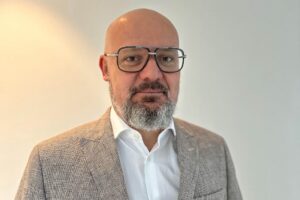

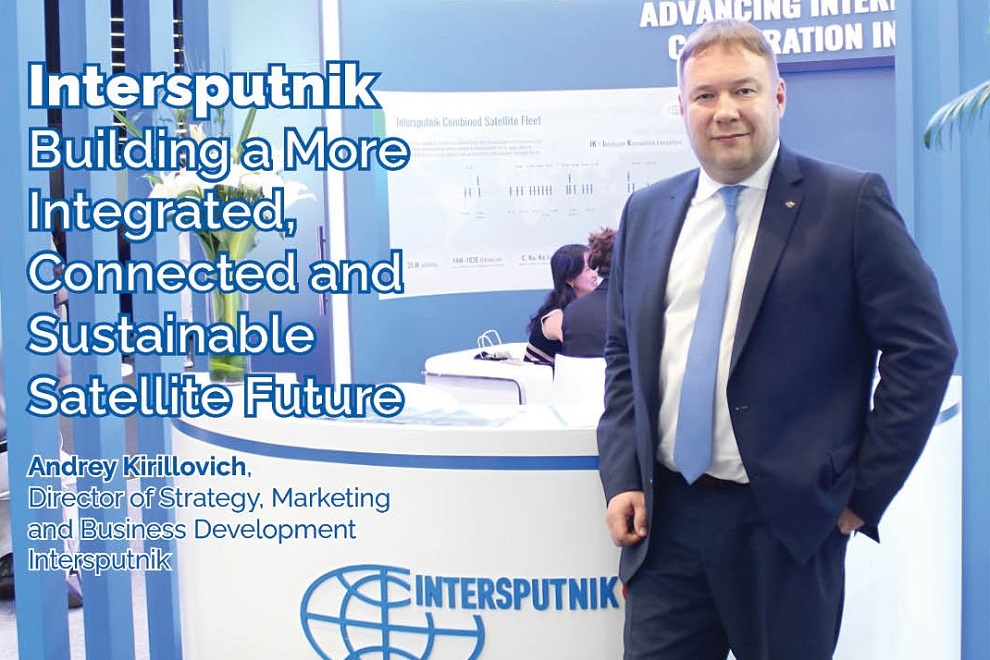

Andrey Kirillovich, Director of Strategy, Marketing and Business Development, Intersputnik
Interview: Gulraiz Khalid
Gulraiz Khalid: How is Intersputnik adapting its strategy as the satellite industry shifts toward multi-orbit and increasingly integrated networks?
Andrey Kirillovich: Intersputnik, being an international intergovernmental organization, throughout its 55-year history, has always been acting for the benefit of its Member States. We see how the satellite industry is evolving and use our vast experience in building communications and broadcasting networks via satellite to ensure that our Members and Signatories, located on almost all continents, can take the best of the GSO and non-GSO worlds. And that seamless integration with terrestrial networks is done in a proper way, not harming the overall performance of the national backbone and internal grid. The majority of our Members represent developing regions, so traditional video distribution still plays a significant role in their broadcasting strategies. And here a GSO satellite is the best solution. On data access / distribution, we assume that in case a non-GSO system meets national legislation and receives a license to operate, it can provide the nation with fast-deployable mass internet access. However, a full shift to large satellite constellations for internet access may seriously or completely cease national broadband initiatives in the country, having consequences for the GDP value and overall digital infrastructure development, as well as for national data and connectivity sovereignty. As a result, we see that more and more national administrations start looking at a national communications GSO satellite. This means that the nations will mix non-GSO constellations for individual mass internet with governmental, more sensitive traffic to be routed via national small GSO satellites. The pricing for the latter is going down now.
GK: Where do you see the strongest growth opportunities for satellite connectivity over the next three to five years?
AK: Mobility for sure. End-user satellite terminals are becoming smaller and cheaper, so any passenger transport will sooner or later be equipped with in-flight, at-sea or on-the-road connectivity. Also, since the price of the CPE (customer premises equipment) goes down with mass production, new market segments will be opening in travel, banking, point of sale, forestry, first response and other segments, where before it was impossible to equip every unit or team with a satellite terminal. One more promising option is backup. With reduced CPE pricing, more businesses and network operators start using satellite as a primary or secondary backup solution.
GK: How are changing customer requirements influencing Intersputnik’s partnerships and service portfolio?
AK: Rapidly evolving technologies and corresponding changes in the international regulatory landscape have created a serious need for training. Today, the shortage of qualified personnel is becoming one of the factors limiting the development of modern satellite communications systems in various regions of the world. We strive to change this situation. For this purpose, Intersputnik is undertaking extensive work aimed at developing the competencies and improving the qualifications of professionals from the Organization’s Member States. Two satcom training seminars were arranged in 2025 in Azerbaijan and Kazakhstan in partnership with the International Telecommunication Union (ITU).
And in November 2025, in Baku, at the World Telecommunication Development Conference (WTDC-25), Intersputnik and ITU signed a cooperation agreement to promote industry capacity building and digital skills for professionals in the field of satellite communications and broadcasting technologies. The purpose of the agreement is to create a sustainable platform for training qualified personnel. The project involves the development of a comprehensive training programme and an online platform for remote access to materials. This will give impetus to the implementation of satellite projects, improve the quality of services and open up opportunities for international cooperation.
Intersputnik’s capacity-building efforts also extend to supporting young professionals from the Organization’s Member States as part of our Youth Far Beyond Borders (YFBB) project. Since 2023, more than 100 young people from 16 countries have taken part in it.
GK: What role do you expect 5G NTN and direct-to-device connectivity to play in the future satellite ecosystem?
AK: Satellite has finally become an integral part of the Mobile Network Operators (MNO) ecosystem. The latest Mobile World Congress in Barcelona this spring featured satellite connectivity and D2D (Direct-to-Device) as one of the major developments for the mobile industry. There are still many questions to be answered: on the technology, spectrum, throughput and licenses, but the major concern is what business model will be finally successful: D2D operators offering their infrastructure for expanding terrestrial MNO network, or D2D providers acting as a separate MNO? The time will show, but for sure the satellite has gained its place in the mobile networks of the future.
GK: As satellite deployments and orbital congestion increase, how is Intersputnik approaching space sustainability and the responsible use of orbital resources?
AK: Intersputnik has always been supporting space sustainability and the prudent use of orbital resources. Our Organization enjoys the status of a permanent observer with the United Nations Committee on the Peaceful Uses of Outer Space (COPUOS). Intersputnik has accepted the obligation to comply with the Outer Space Treaty and the responsibility for compliance with this treaty, as well as the rights and obligations under three other UN treaties on outer space. We are closely following discussions on the long-term sustainability of outer space activities at COPUOS and beyond, and are supporting initiatives aimed at space sustainability. For example, in 2021 Intersputnik was one of the signing parties to the Space Industry Debris Statement on minimizing and preventing, where possible, any new debris created as a result of space missions, developed within the framework of the World Economic Forum. Moreover, after the International Telecommunication Union placed greater emphasis on this issue as part of its role in managing radio-frequency spectrum and satellite-orbit resources, the Intersputnik Executive Director Elina Morozova was appointed as an editor of the Handbook on Best Practices for the Sustainable Use of Frequencies and Associated Non-GSO by Space Radiocommunication Services, currently being developed within the ITU Radiocommunication Sector.
GK: Looking ahead, what will be Intersputnik’s key priorities as competition and investment in the global space sector accelerate?
AK: As was said earlier, Intersputnik is an international intergovernmental organization uniting member countries and Signatories from all over the world. So, for us it is essential to bring value to our stakeholders. It can be satellite communications or broadcasting networks deployment, reselling of their national satellite bandwidth on the international market, assistance and guidance for their national satellite programmes, implementation of the satcom segment in their national digital infrastructure development, or last but not least – proper training on the new technologies and regulations. Whatever the challenge, Intersputnik is here to support its Members, Signatories and the wider satcom community.