
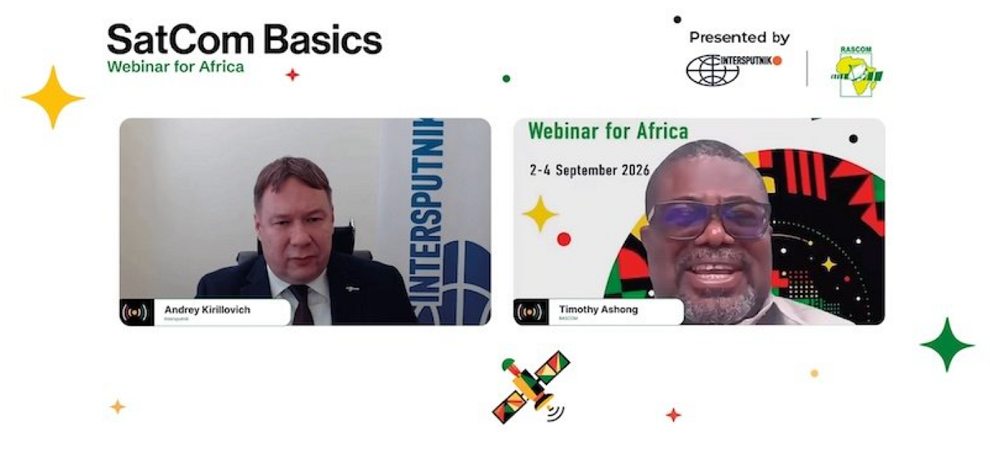

On 2–4 September 2026, Intersputnik and the Regional African Satellite Communications Organization (RASCOM) arranged an international webinar, SatCom Basics, dedicated to the fundamentals of satellite communications in the format of an online training course for telecom experts. The event was attended by nearly 200 representatives from 41 African countries.
The main purpose of the webinar was to provide employees from national communications administrations and regulators of African countries with basic knowledge and fundamentals of satellite communications and broadcasting technologies, their implementation and application, the specifics of satellite network regulation and current trends in the development of global and regional satellite communications systems. The event was held as part of the Intersputnik Development Strategy approved by the Members and Signatories of Intersputnik for collaborations with industry-specific intergovernmental organizations, as well as in accordance with the Cooperation Agreement concluded between Intersputnik and RASCOM in 2024.
Attendees of the webinar learned about the current status and development trends of satellite systems and the satellite communications market. World-class experts informed them about the peculiarities of using different orbits – low, medium and geostationary ones – the advantages and disadvantages of each, and the multi-orbit approach.
To assist the audience in developing a comprehensive understanding of satellite networks as a single integrated system, information on the space segment was seamlessly aligned with information on the ground segment and the radiofrequency ranges used. The webinar programme presented all elements of ground stations — antennas, modems and channelling equipment — as a single system. The speakers focused on the deployment and operation of networks of various topologies, methods for calculating radio link budgets, and specifics of the operating and managing gateway stations, hubs and network operation centres (NOCs).
The attendees showed particular interest in the webinar’s third day, which focused on regulatory issues — radio spectrum management, ITU application procedures, frequency coordination and methods for preventing interference with other networks.
The webinar was attended by approximately 200 professionals in the fields of telecommunications, satellite communications and regulation from 41 African countries – member countries of Intersputnik and RASCOM. Among them were representatives of industry-specific national agencies and ministries, employees of satellite operators, government service providers and VSAT operators, who noted the relevance of the webinar programme. The knowledge gained will allow them to more harmoniously build national regulatory policies and operator business models in the future. Representatives from related industries gained insight into the potential of satellite technologies to support various industries and business areas.
With a unified technical and regulatory framework, attendees of the webinar will also be able to further implement joint programmes and build regulatory policies based on equal and mutually beneficial cooperation.
Africa is a dynamically developing region that places special demands for accelerated infrastructure development. Satellites have traditionally made it possible to build communications infrastructure in a short period of time, that is why so much attention is currently paid to this technology. The general consensus was that the webinar provided a positive impetus for the African telecom experts to proceed further with their professional development and enriching competences. This will contribute to solving the staffing problem in the satellite industry in the near future and increase the efficiency of satellite technologies to address the digital divide.