

MWC Barcelona 2026 was more than a trade show; it was a celebration of two decades of innovation in the heart of Catalonia. Opening with a poignant reflection on twenty years of partnership with the city, the GSMA welcomed over 109,000 attendees to the Fira Gran Via. The overarching narrative, set by GSMA Director General Mats Granryd, focused on a three-pronged challenge: completing the global transition to 5G Standalone (SA), rising to the multifaceted challenges of Artificial Intelligence (AI), and fortifying digital safety in an increasingly complex threat landscape.
The event’s theme, “The IQ Era,” signaled a shift in the telecommunications industry’s identity. No longer content to be the “pipes” of the digital world, mobile operators and infrastructure giants showcased their evolution into intelligent platform providers. This transition was anchored by the launch of the GSMA Open Telco AI initiative, a collaborative framework designed to accelerate the development of “telco-grade” AI—systems that are not only intelligent but also secure, reliable, and interoperable across global borders.
Keynote Highlights & Global Leadership
The keynote sessions at MWC Barcelona 2026 served as the strategic heartbeat of the event, bringing together a record-breaking concentration of global decision-makers. With over 1,700 speakers—of which 40% held C-suite positions and 35% were women—the stage represented a cross-sector consensus on the future of intelligent connectivity.
1. “Leading the Future – Intelligent, Inclusive, Unstoppable”
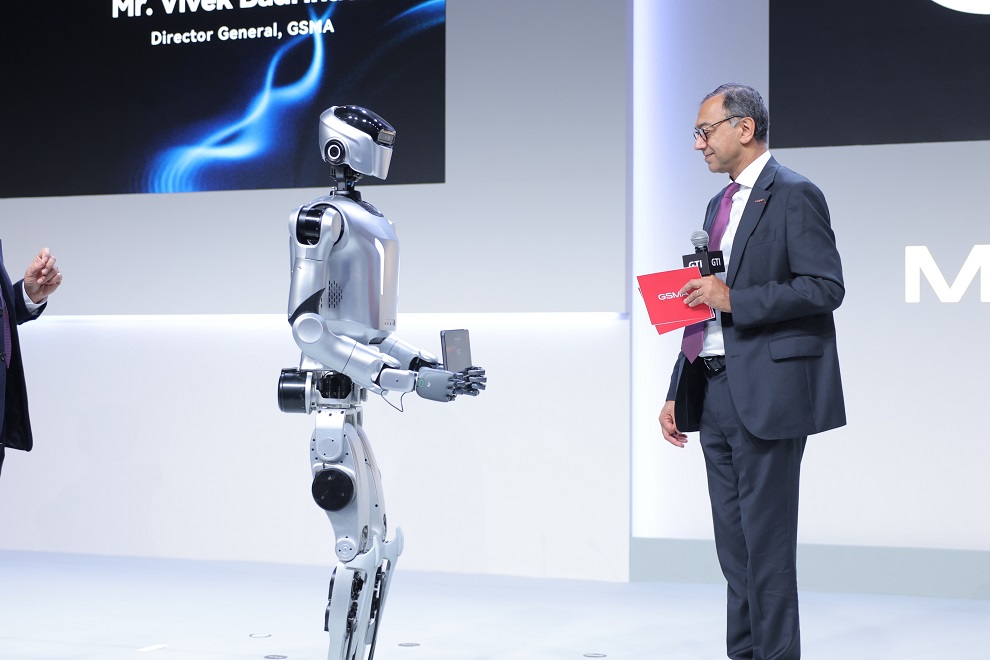
The opening session addressed the industry’s pivot toward sovereign and secure AI. Vivek Badrinath, Director General of the GSMA, opened the congress by framing the “IQ Era” as a moment of structural reset. He was joined by a panel of industry titans who explored the convergence of infrastructure and intelligence:
- Sunil Bharti Mittal, Founder and Chairman of Bharti Enterprises: Emphasized the “usage gap,” noting that while technology has advanced, the industry’s moral mission remains to make connectivity universally affordable for the 3.1 billion people still excluded from the digital economy.
- Christel Heydemann, CEO of Orange Group: Championed the transition to AI-native networks, arguing that telcos must evolve from connectivity providers into “digital platform orchestrators.”
- John Stankey, Chairman and CEO of AT&T: Outlined the necessity of scaling 5G-Standalone (SA) to support the massive data demands of generative and agentic AI.
- Margherita Della Valle, CEO of Vodafone Group: Discussed the importance of fair-share policies and industrial consolidation to fund the next generation of European infrastructure.
- Tim Peake, Astronaut with the British European Space Agency (ESA): Brought a unique perspective on the “outer limits” of connectivity, discussing how satellite-to-cell integration is transforming global coverage.
2. Innovation in Device and Network Intelligence
Keynote sessions throughout the week focused on the shift toward Agentic AI—systems that move beyond simple prompts to autonomous execution.
- Cristiano R. Amon, President and CEO of Qualcomm Incorporated: Delivered a vision for “On-Device AI,” explaining how processing at the edge is the only sustainable way to handle the trillions of AI interactions predicted for the 2030s.
- Justin Hotard, President and CEO of Nokia: Co-presented a roadmap for 6G, describing it as a “sensing network” that will act as a digital twin for the physical world.
- Chaobin Yang, Executive Vice President and CEO of the ICT Business Group at Huawei Technologies Co., Ltd.: Showcased Huawei’s “Agentic MBB” framework, demonstrating how AI agents are now managing complex 5.5G networks to achieve “zero-bit, zero-watt” energy efficiency.
- He Biao, CEO of China Mobile: Articulated a future where the network itself is the computer, treating AI as a fundamental utility rather than a standalone application.
3. The Ministerial Programme: Policy and Digital Sovereignty
The Ministerial Programme convened 188 delegations and 54 ministers to discuss the regulatory framework required for a sovereign tech future.
- Henna Virkkunen, European Commission Executive Vice-President for Tech Sovereignty, Security, and Democracy: Delivered a cornerstone address titled “Advancing Europe’s Telecom Framework,” calling for more single-market competitiveness and resilience in the face of rising geopolitical rivalries.
- Shri Jyotiraditya M. Scindia, Union Minister of Communications, India: Highlighted India’s success in driving down data costs and outlined his vision for “Built for What’s Next,” emphasizing affordable, human-centric AI ecosystems.
- Óscar López Águeda, Minister for Digital and Civil Service Transformation, Spain: Welcomed the industry for its 20th year in Barcelona, focusing on Spain’s leadership in digital rights and the ethical deployment of AI.
4. Cross-Industry Disruptors and the “Entertainment Act”
MWC 2026 signaled that the “mobile” industry now encompasses everything from space exploration to Hollywood.
- Gwynne Shotwell, President and COO of SpaceX: Detailed the evolution of Starlink’s direct-to-cell services and the role of reusable rockets in lowering the cost of global satellite connectivity.
- Johanna Faries, President of Blizzard Entertainment: Discussed the “Next Act of Entertainment,” exploring how AI and high-speed networks are merging gaming, creativity, and social interaction into unified immersive experiences.
- Aaron Paul, Actor, Producer, and Entrepreneur: Joined a fireside chat on “Reclaiming Presence,” advocating for technology that enhances human connection rather than distracting from it—a theme reflected in the rise of minimalist “minimalist devices.”
- Karandeep Anand, CEO of Character.AI: Explored the future of personalized AI companions and how they will redefine the human-machine interface.
Huawei and the Infrastructure Revolution: From 5G to 5.5G
Huawei maintained its position as the primary architect of the next-generation network. Its presence in Hall 1 was centered on the commercial deployment of 5.5G (5G-Advanced), which Huawei argued is the essential bridge to the 6G future. The company’s “Agentic MBB” (Mobile Broadband) was a highlight, demonstrating how AI agents can autonomously manage network congestion and energy efficiency.
A major milestone for Huawei was the reception of multiple Global Mobile (GLOMO) Awards. Most notably, Huawei, in collaboration with China Telecom, was recognized for its pioneering work in Non-Terrestrial Networks (NTN). Their solution for “Direct-to-Satellite” communication allows standard consumer smartphones to connect directly to GEO satellites for voice and data—a feat that effectively eliminates “dead zones” in remote regions. Furthermore, Huawei’s “0 Bit 0 Watt” energy-saving technology set a new benchmark for sustainability, proving that high-performance 5.5G networks can actually reduce their carbon footprint by powering down components to near-zero when no traffic is detected.
The Rise of “Agentic AI” and Device Innovation
If 2025 was the year of Generative AI, 2026 was the year of Agentic AI. The keynote stages were dominated by discussions on AI systems that don’t just answer questions but take autonomous actions.
In the consumer hardware space, the Honor “Robot Phone” became the most talked-about device of the week. By integrating a micro-gimbal camera and an AI agent that “learns” user behavior, the phone acts as a proactive personal assistant. This was complemented by the Xiaomi 17 Series, which continued to push the boundaries of mobile photography through its partnership with Leica, and the Apple iPhone 17 Pro, which secured the GLOMO for “Best Smartphone” due to its refined integration of on-device AI and the A19 Pro silicon.
Democratization of technology was also a key focus. The Infinix HOT 60 Pro+ was awarded “Best Smartphone under $150,” highlighting that high-speed connectivity and AI features are no longer exclusive to the premium segment.
Talent, Startups, and Global Collaboration
The Talent Arena, now in its third year, solidified its position as Europe’s leading digital talent hub, attracting 25,000 visitors. This initiative addressed the critical “skills gap” by connecting developers and engineers with the world’s leading tech employers. Simultaneously, the 4YFN (Four Years From Now) startup event celebrated a landmark partnership, signing a Memorandum of Understanding (MOU) with the Korea International Trade Association (KITA) to foster cross-border innovation between European and Asian startups.
The GSMA also utilized the Barcelona platform to look toward the future of Latin American connectivity, announcing that M360 LATAM 2026 would return to Mexico City. This move emphasizes the GSMA’s commitment to ensuring that the “IQ Era” is a global phenomenon, not limited to developed markets.
The Funding Frontier: GSMA Foundry and ESA
One of the most significant financial announcements of the week came from the GSMA Foundry and the European Space Agency (ESA). They announced access to new funding worth up to €100 million for projects focusing on the convergence of terrestrial and satellite networks. This funding is specifically targeted at AI-driven NTN (Non-Terrestrial Networks), Device-to-Device (D2D) satellite communication, and the early R&D phases of 6G. This partnership underscores the strategic importance of “ubiquitous connectivity”—the idea that a user should never lose connection, whether they are in a skyscraper or the middle of the ocean.
The 2026 GLOMO Awards: Celebrating Excellence
2026 GLOMO Awards winners
Chairman’s Award
Keeping the World Connected in Crisis: Presented to Doreen Bogdan-Martin, Secretary-General of the International Telecommunication Union & Kelly Clements, United Nations Deputy High Commissioner for Refugees
Outstanding Achievement
Lifetime Achievement Award: Sunil Bharti Mittal, Founder and Chairman, Bharti Enterprises
Government Leadership Award: Socialist Republic of Viet Nam
Mobile Tech
CTO Choice: Outstanding Mobile Technology Award: LG Uplus for ixi Guardian, an End-to-End Security Suite for Telco’s AI Agent
Best Mobile Network Infrastructure: Huawei for UWB AAU series with Giga Performance and Efficiency
Best Mobile Technology Breakthrough: Cohere Technologies for Pulsone Multi-G for ISAC and NTN
Best Digital Tech Breakthrough for companies with under $100 million Annual Global Revenue: Cumucore for Time Sensitive Network over 5G
Best Network Security and Fraud Prevention: LG Uplus for for ixi-Guardian, an end-to-end security suite for telco’s AI Agent
Best AI‑Powered Network Solution: China Mobile and Huawei for “AI+Network” Operation Transformation
Best Cloud Solution: SK Telecom for SKT Haein GPU Cluster
Best NTN Solution: China Telecom and Huawei for System Design, Key Technologies, and Scale Application of the Smartphone Direct Connection to GEO Satellite
Digital Everything
Best Mobile Operator Service for Connected Consumers: Telkomsel and Huawei for Jaringan Prioritas with Guaranteed Experience in High-Density Connectivity with UE Logo
Best Private Network Solution: China Telecom, ZTE, AgiBot and DroidUp for EasyOn 5G-A-RobotNet: Intelligent Backbone for Humanoids
Best Mobile Innovation for Connected Health and Wellbeing: China Mobile, Huawei and Ant Group for Ubiquitous AI Health Assistant
Best AI‑Enabled Customer Experience: e&, Amdocs and NVIDIA for Agentic-AI Customer-Experience Transformation at e&
Best FinTech & Digital Commerce Innovation: Safaricom and Huawei for Ziidi Wealth Platform
Open Gateway Challenge: China Mobile, China Mobile Hangyan, JD.com and ZTE for AI-Powered Open Gateway Bridging AI Systems and Network Infrastructure
Device
Best Smartphone: Apple iPhone 17 Pro series
Disruptive Device Innovation: Honor for the implementation and commercialisation of silicon carbon battery technology
Best Connected Consumer Device: Garmin, Skylo and Sony Altair for Garmin fēnix® 8 Pro Multisport Smartwatches
Best Device <$150 (Entry Level): Infinix Mobility Limited for HOT 60 Pro+
Best in Show: Samsung Galaxy S26 Ultra
Tech4Good
Digital Inclusion & Usage‑Gap Impact: Dots for Inc. for DC Box Network – A Village-Scale Digital Hub Connecting the Unconnected in Rural Africa
Best Mobile Innovation supporting Emergency or Humanitarian Situations: Metro Pacific Health Tech for mWell
Best Use of Mobile for Accessibility & Inclusion: China Mobile and Huawei for Ubiquitous Mobile Health Assistant
Best Mobile Innovation for Climate Action: K-water for SWNM: AI-Powered Smart Water Networks, Climate Action
Best Mobile Innovation for Enhancing the Lives of Children and Young People: China Telecom, CSEF and Huawei for Qingjiao Plan in Lancang County
The #ChangeTheFace Award: Lindsey Nefesh-Clarke, Founder & CEO, W4.org
Marketing Excellence
Best Event Activation: China Telecom, R&J and ZTE for 5G-A powered concert live streaming
CMO Marketing Campaign Award: Singtel and Hogarth Worldwide for CUBICLΣ LIFE
Marketing for Good: LGU+ for the Integrated Marketing Campaign Empowering ixi-Guardian and ixi-O as Korea’s Leading AI Security & Call Agent Service
Sustainability and Ethical AI: The Moral Compass
Throughout the daily highlights—from the Tuesday “Green Tech” sessions to the Thursday closing panels—sustainability remained a non-negotiable priority. The industry’s shift toward “Intelligent Infrastructure” is being driven as much by the need to save energy as the need to increase speed. Discussions on Ethical AI also took center stage, with the GSMA advocating for a “Human-in-the-Loop” approach to ensure that autonomous AI agents remain under human oversight, particularly in critical infrastructure management.
The Roadmap to 2027 and Beyond
As MWC Barcelona 2026 drew to a close, the path forward was well-defined. The industry has successfully navigated the “5G Trough of Disillusionment” and entered a period of renewed growth driven by 5.5G and AI. The 20th anniversary in Barcelona served as a reminder of how far the mobile ecosystem has come—from simple voice calls to a world where AI-powered networks manage themselves and satellites provide a safety net for the entire planet.
The “IQ Era” is officially here. As the delegates departed the Fira Gran Via, the focus turned toward the next frontier: the standardization of 6G and the further miniaturization of AI into wearables and robotics. MWC 2026 proved that the mobile industry remains the foundational engine of the global digital economy, more intelligent and more vital than ever before.