
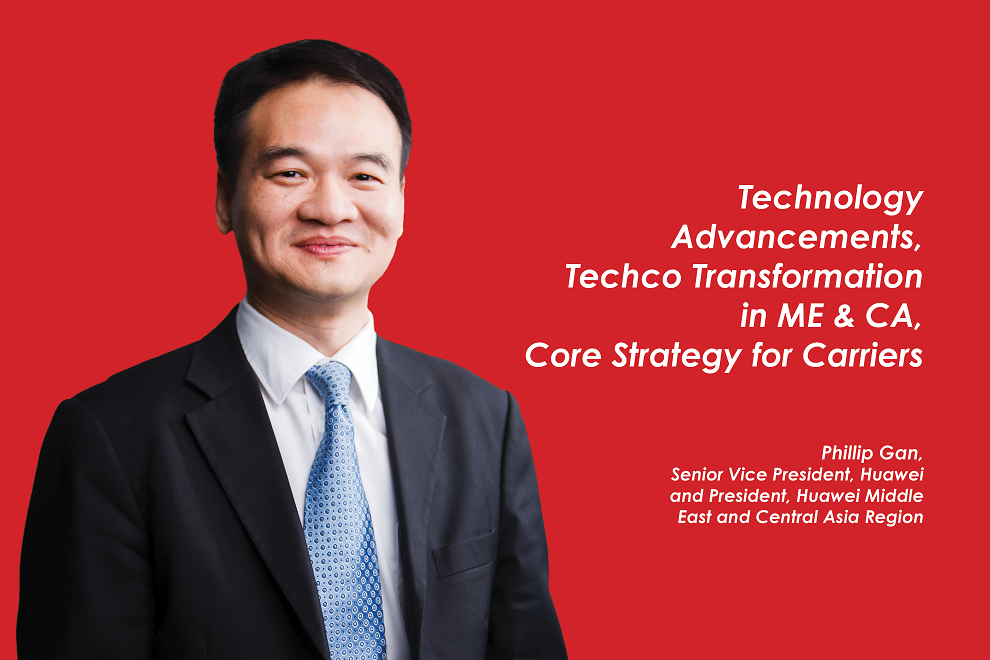

Phillip Gan, Senior Vice President, Huawei and President, Huawei Middle East and Central Asia Region
Shaping the Digital Future: Transformative Growth in the Middle East and Central Asia
Digital transformation in the Middle East and Central Asia is no longer just a trend—it’s a necessity for businesses navigating an increasingly interconnected world. As Regional President, I’ve had the privilege of traveling extensively throughout these regions and witnessing the extraordinary pace of change. Today, technology has evolved from being merely an enabler to becoming a powerful catalyst for growth, innovation, and competitiveness—shaping the future of entire economies.
Take 5G, for example. Countries like the UAE and Saudi Arabia are at the forefront, building robust 5G networks that serve as critical infrastructure for digital economic development. According to GSMA, 5G is expected to contribute nearly $60 billion to the region’s GDP by 2030, representing 13% of the total economic impact from mobile technologies. This figure highlights the transformative power of bold investment and strategic foresight. Beyond faster internet, these networks are enabling real-time applications, powering smart cities, and creating connected ecosystems—paving the way for innovations from IoT to AI-driven solutions.
“5G is projected to contribute nearly $60 billion to the region’s GDP by 2030, accounting for 13% of the annual economic impact of mobile technologies”
The rapid development of fiber-optic infrastructure is equally noteworthy. It supports urban growth, bridges the digital divide in Central Asia, and fosters inclusivity across rural and remote communities. Fiber connectivity ensures people, businesses, and ideas are interconnected—laying the groundwork for a truly digital era.
The digital economy is emerging as a major engine of regional growth. This year, e-commerce in the Middle East is projected to reach $50 billion. This surge reflects more than financial gains; it reveals a thriving ecosystem of entrepreneurs, logistics providers, digital payment platforms, and customer-centric innovations. For business leaders, this moment presents an exciting opportunity to contribute to this momentum and accelerate progress.
Artificial Intelligence is further propelling this transformation. As AI capabilities expand, regional strategies are evolving, driving rapid changes across industries. For leaders, this represents a historic opportunity to ensure technology advances societal well-being. Collaboration—whether through government partnerships, exploration of new markets, or deploying impactful tech solutions—has become the cornerstone of success. Accelerating digital transformation, expanding inclusive connectivity, and promoting societal advancement are key to this purposeful progress.
The Middle East and Central Asia are no longer passive consumers of global tech—they’re emerging as creators, innovators, and global leaders. This extraordinary transformation marks a pivotal chapter in the region’s history. As a leader in this space, I remain deeply committed to helping shape this dynamic digital future.
Driving Innovation: 5.5G, Cloud, AI, and Sustainability at the Core of Digital Transformation
Next-generation technologies like 5.5G, cloud computing, AI, and digital power are no longer optional—they’re strategic imperatives for competitive growth in today’s digital world.
5.5G and F5.5G: Revolutionizing Connectivity
The next evolution in connectivity, 5.5G and F5.5G, offer ultra-fast speeds of up to 10 Gbps, ultra-low latency (as low as 10 milliseconds), and enhanced reliability. These capabilities unlock transformative applications across public services, transportation, energy, utilities, and financial sectors.
Cloud and AI: The Innovation Engine
Cloud computing enables efficient data storage, management, and analytics. When combined with AI, it enhances decision-making, automates processes, and drives operational excellence—redefining how businesses create value.
AI is central to digital transformation, not only driving economic growth but also solving complex social challenges. The Middle East is positioning itself as a global AI hub, with GCC countries striving to become the world’s “third center” for AI. Governments and enterprises in the UAE and Saudi Arabia are heavily investing in digital infrastructure and high-tech industries, united by a clear vision.
Advanced AI models like DeepSeek are revolutionizing data analysis, offering improved efficiency, lower costs, and reduced energy consumption. These breakthroughs are accelerating industry-wide digital transformation and propelling the region into a new era of intelligent innovation.
Sustainability: A Core Priority
In response to global climate concerns, sustainability has become integral to digital transformation. Nations such as Saudi Arabia, the UAE, Qatar, and Central Asian countries are leading initiatives like the Middle East Green Initiative and Net Zero by 2050. From green data centers to energy-efficient technologies, companies are embedding sustainability into their innovations—aligning business growth with global environmental goals.
Techco Transformation: Redefining Telecommunications in the AI Era
A new chapter is unfolding in the regional telecom sector. Middle Eastern operators are embracing the Telco-to-Techco transformation, underpinned by 5.5G networks, AI, and cloud technologies. This evolution is redefining operators as providers of digital experiences and intelligent ICT services—far beyond traditional connectivity.
Industry leaders like e&, stc, and Zain are setting the pace by creating new growth verticals and aligning with strategic national initiatives, such as Saudi Arabia’s 10Gbps Society and the UAE’s AI Strategy.
Central to this transformation is the shift in business models, operations, and infrastructure. Huawei’s Techco 1.0 framework, introduced last year, empowers operators to adopt agile, innovative approaches that unlock new value across cloud, IoT, AI, 5G, and cybersecurity. By embracing this model, telcos can foster cross-industry innovation, optimize operations, and improve quality of life through digital advancement.
This transition not only enhances telco capabilities but also enables broader collaboration and integration with other industries. With AI and automation at the core, operators are improving efficiency, reducing costs, and delivering exceptional user experiences.
“Central to this transformation is the shift in business models, operations, and infrastructure. Huawei’s Techco 1.0 framework, introduced last year, empowers operators to adopt agile, innovative approaches that unlock new value across cloud, IoT, AI, 5G, and cybersecurity”
Huawei: Leading the Region’s AI-Driven Digital Transformation
Huawei has long been a driving force behind ICT innovation and digital transformation in the Middle East and Central Asia. Our success stems from a strong R&D foundation and a deep commitment to our partners and customers. For over 27 years, we have worked closely with stakeholders across 21 countries, delivering advanced connectivity, computing, and intelligent solutions that shape the region’s digital future.
Our comprehensive AI strategy empowers transformation across consumer tech, ICT infrastructure, vehicles, and industries. With our full-stack AI capabilities—spanning computing, cloud platforms, models, and frameworks—we support solutions like DeepSeek, now hosted on Huawei Cloud in Riyadh. This enables the region to accelerate AI adoption while enhancing technological sovereignty through platforms like Kunpeng and open-source ecosystems such as OpenEuler.
Huawei is also advancing green ICT innovations aimed at building net-zero cities and energy-efficient solutions across sectors such as manufacturing, transport, and construction. Our AI-driven platforms help businesses optimize operations while achieving environmental goals—supporting a smarter, greener future for all.
Talent development remains a core pillar of our mission. Through extensive training and education initiatives, Huawei has built 240 ICT academies and 10 Huawei Authorized Learning Partners (HALPs), training more than 50,000 professionals annually. We are committed to nurturing the next generation of tech leaders across the region.
Conclusion
The AI-driven digital transformation in the Middle East and Central Asia is a journey of both challenge and immense opportunity. By adopting cutting-edge technologies, accelerating techco transformation, and investing in talent, regional operators are paving the way toward a future defined by innovation and inclusive progress. As we move forward, the potential for growth, impact, and societal benefit is limitless. Through shared vision and collaboration, a smarter, greener, and more connected future is not just possible—it is already taking shape.