



As satellite connectivity moves deeper into mainstream telecoms, cloud and enterprise infrastructure, operators are discovering that the next revenue opportunity may not come from selling more capacity — but from combining networks, orbits and platforms into seamless services.
Gulraiz Khalid
The global satellite communications industry is entering one of the most consequential periods in its history.
For decades, the commercial model was relatively straightforward: operators placed large satellites in geostationary orbit, sold capacity to broadcasters, governments, telecom operators and enterprises, and refreshed those assets over long investment cycles.
That model has been fundamentally disrupted.
Low Earth Orbit (LEO) constellations have introduced enormous amounts of new capacity, dramatically lower latency and a different cost structure. Cloud computing has changed how enterprises consume communications infrastructure. Software-defined networking is making connectivity increasingly programmable, while 5G Non-Terrestrial Networks (NTN) are beginning to erase the technical boundary between terrestrial mobile and satellite networks.
At the same time, customers increasingly expect connectivity everywhere — on an aircraft, aboard a ship, at a remote industrial site, inside a military deployment or simply on an ordinary smartphone.
The result is an industry shifting from satellite capacity to connectivity platforms.
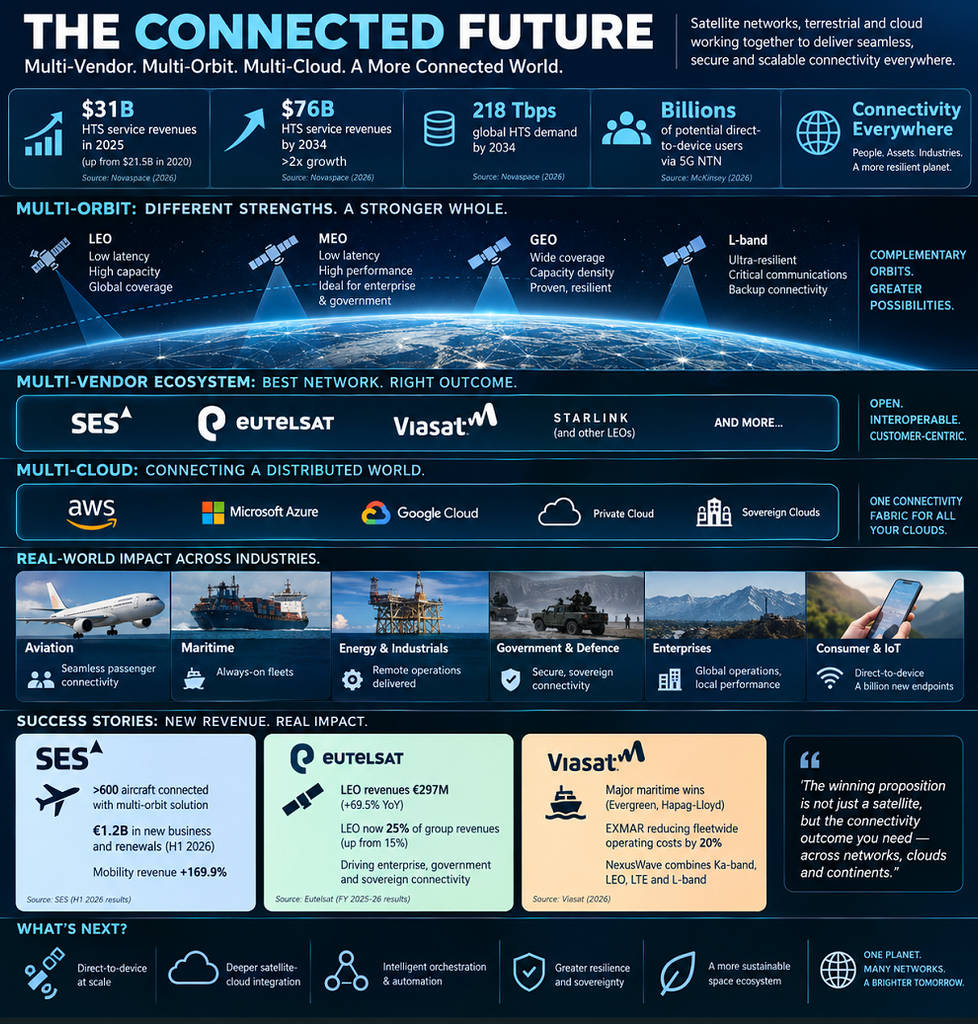
According to Novaspace, global High Throughput Satellite demand could reach 218 Tbps by 2034, while associated service revenues are expected to more than double to approximately $76 billion. HTS service revenues already increased from $21.5 billion in 2020 to nearly $31 billion in 2025.
The opportunity, however, will not necessarily be distributed evenly.
LEO has reset the economics of satellite broadband, while traditional GEO operators face pressure in legacy businesses including video distribution and wholesale capacity. Meanwhile, rapidly expanding opportunities in mobility, government, defence, enterprise connectivity and direct-to-device services are creating entirely new revenue pools.
The strategic question is therefore changing.
It is no longer simply: who has the best satellite?
Increasingly, it is: who can assemble the best network?
“The strategic question is therefore changing.
It is no longer simply: who has the best satellite?
Increasingly, it is: who can assemble the best network?”
From Orbit Competition to Orbit Integration
The first stage of the new satellite era was largely defined as GEO versus LEO.
That distinction is becoming less useful.
Each orbital architecture has inherent strengths. GEO satellites provide enormous geographic coverage and can efficiently deliver capacity to large areas. LEO provides significantly lower latency and increasingly large amounts of broadband capacity. MEO occupies an important position between the two and has become particularly valuable for high-performance government and enterprise applications.
Instead of forcing customers to choose one architecture, operators are increasingly combining them.
The logic is compelling.
A maritime operator, for example, may use LEO for high-speed broadband, GEO Ka-band for additional capacity, L-band for highly resilient backup connectivity and terrestrial LTE when a vessel approaches port.
The customer does not particularly care which network carries each packet.
The customer wants the application to work.
This is turning multi-orbit connectivity into a service layer rather than simply an infrastructure proposition.
SES provides perhaps the clearest illustration of the strategy. Following its acquisition of Intelsat, the group combines extensive GEO infrastructure with SES’s O3b MEO network while also having strategic access to LEO capacity. Its next-generation O3b mPOWER architecture is designed around high-performance, low-latency connectivity for enterprise, mobility and government markets.
And the commercial indicators are significant.
SES reported €1.602 billion in revenue during the first half of 2026. On a reported basis, Networks revenue increased 89%, including 169.9% growth in Mobility and 41.9% growth in Government & Defense, although the figures also reflect the consolidation of Intelsat. The company signed approximately €1.2 billion in new business and renewals during the period and reported a €6.4 billion backlog.
One particularly interesting growth story is aviation.
SES says more than 600 aircraft are now flying with its multi-orbit electronically steered antenna solution, while it secured around 200 additional aircraft wins during the first half of 2026.
This demonstrates where the economics of satellite are heading. The value is increasingly not the raw MHz being sold from a spacecraft; it is the ability to deliver a predictable passenger experience across multiple networks.
Eutelsat: Turning LEO into a Material Revenue Engine
Eutelsat offers another indication of how quickly the revenue mix can change.
Its combination with OneWeb created an operator spanning a substantial GEO fleet and a LEO constellation of more than 600 satellites. Eutelsat consequently positions the two architectures as complementary: GEO providing bandwidth density and stability, with LEO providing low latency and extensive reach.
More importantly, the LEO business is becoming financially meaningful.
For FY2025-26, Eutelsat reported LEO revenues of €297 million, an increase of 69.5%, meaning LEO accounted for approximately 25% of group revenues compared with roughly 15% a year earlier.
That is an important satellite-industry success story.
It demonstrates that LEO is moving beyond the investment and deployment phase and becoming a significant revenue generator for an established satellite operator.
Eutelsat’s emphasis is also different from the mass-market consumer broadband strategy associated with Starlink. Enterprise, telecom, government and sovereign connectivity are central to its positioning.
This could prove particularly important as governments increasingly treat satellite infrastructure as strategic national infrastructure.
Europe’s IRIS² programme, sovereign communications initiatives and growing defence requirements illustrate how geopolitical considerations are creating another major satellite revenue category: resilient and sovereign connectivity.
Satellite operators are therefore increasingly selling something beyond bandwidth.
They are selling redundancy, jurisdiction, security and assured access.
Viasat/Inmarsat: Monetising the Network, Not the Orbit
Perhaps one of the most interesting examples of the multi-network model can be found at sea.
Viasat’s Inmarsat business has been expanding NexusWave, a managed maritime connectivity platform that combines Ka-band, LEO, LTE and L-band connectivity.
Rather than requiring a shipping company to manage separate networks, NexusWave intelligently bonds different connectivity layers into a single managed service.
The commercial traction during 2026 has been notable.
Evergreen Marine committed to a fleetwide upgrade to NexusWave, while Hapag-Lloyd subsequently selected the platform across its global fleet following onboard trials.
Other maritime customers have followed.
One particularly revealing example is EXMAR. The company said deployment of NexusWave would reduce its fleetwide operating expenditure by 20% by consolidating connectivity under a single provider, while improving access to business-critical applications and ship-to-shore communications.
This may be a preview of the broader satellite industry’s future.
The winning proposition is not necessarily:
Here is our satellite.
It is increasingly:
Here is the connectivity outcome you need, and we will decide which networks should deliver it.
That distinction is profound.
Multi-Vendor Is the Next Logical Step
Multi-orbit architecture naturally leads to another transition: multi-vendor satellite networks.
Enterprise customers are unlikely to want their mission-critical infrastructure entirely dependent upon one constellation.
The reasons include resilience, geographic availability, regulatory requirements, pricing, cybersecurity and increasingly sovereignty.
A global enterprise could therefore combine capacity from several operators — potentially using one LEO constellation in one geography, another elsewhere, GEO or MEO for committed capacity and terrestrial 4G/5G whenever available.
The terminal and network orchestration layers become critical.
Electronically steered antennas, software-defined networking, intelligent traffic routing and network APIs can eventually allow applications to select connectivity dynamically according to latency, cost, security, availability or service-level requirements.
That creates an important new position within the satellite value chain.
The company controlling the orchestration layer may eventually hold a relationship with the customer that is just as valuable as the company owning the spacecraft.
Satellite connectivity consequently begins to resemble cloud computing.
Enterprises rarely want their digital architecture dictated entirely by one server or one data centre. Increasingly, they do not even want to depend exclusively upon one cloud.
Satellite communications could evolve in much the same way.
Satellite Meets the Multi-Cloud Enterprise
This brings the industry to the third major transition: multi-cloud satellite connectivity.
Enterprises have spent the past decade moving applications and data into AWS, Microsoft Azure, Google Cloud and private clouds. Remote sites, ships, aircraft and government installations increasingly need direct and secure access to those environments.
Satellite therefore becomes part of enterprise cloud architecture.
Instead of thinking:
Remote Site → Satellite → Internet
the architecture increasingly becomes:
Remote Site → Best Available Network → Intelligent Connectivity Platform → Enterprise Cloud Environment
A multinational energy company could operate hundreds of remote assets connected through different satellite constellations. Traffic generated by those facilities might simultaneously need to reach applications distributed across AWS, Azure, Google Cloud and private data centres.
The connectivity platform must therefore understand both worlds.
It must become multi-orbit above the Earth and multi-cloud on the ground.
The connectivity platform must therefore understand both worlds. It must become multi-orbit above the Earth and multi-cloud on the ground.
SES already describes managed services capable of providing private connectivity from its gateways into customer networks and cloud-based applications, including connectivity involving major cloud environments such as AWS.
As satellite and cloud become more tightly integrated, entirely new commercial opportunities emerge: cloud-connected satellite services, edge computing, IoT aggregation, cybersecurity, AI processing, data analytics and application-specific connectivity.
Operators can consequently move higher up the value chain.
Instead of earning revenue only for transporting bits, they can participate in the digital services those bits enable.
Direct-to-Device Could Expand the Addressable Market Again
Another major frontier is emerging through 5G NTN and direct-to-device connectivity.
The long-term objective is straightforward: ordinary consumer and IoT devices should increasingly be able to communicate through satellites without specialised satellite terminals.
McKinsey identifies both LEO consumer broadband and direct-to-device connectivity as satellite markets moving from niche applications toward mainstream telecom relevance. It also identifies several emerging commercial models, including MNO-led satellite add-ons, device-manufacturer-led services, satellite-led hybrid mobile offerings and aggregation platforms capable of connecting operators to multiple satellite networks through a common integration layer.
The significance is enormous.
The traditional satellite market has been constrained partly by specialised hardware.
NTN changes the potential endpoint from millions of satellite terminals to billions of smartphones, vehicles, sensors and connected machines.
Early services may focus on messaging, emergency communications and low-bandwidth IoT. Over time, improving satellite capacity, spectrum availability, chipsets and standards could support richer voice and data services.
Once again, however, the most interesting opportunity may be orchestration.
A future smartphone may move between terrestrial 5G and multiple satellite networks without the consumer needing to know — or care — which infrastructure is providing the connection.
What Comes Next?
The satellite industry of the next decade will therefore look considerably different from the industry that preceded it.
GEO is not disappearing.
Neither will LEO replace every other architecture.
Instead, the market is beginning to recognise that different networks solve different problems.
LEO provides latency and scale. MEO provides powerful low-latency connectivity for demanding enterprise and government applications. GEO provides coverage, capacity density and established economics. L-band provides resilience. Terrestrial 5G and fibre provide enormous capacity wherever infrastructure exists.
Cloud platforms provide the applications and computing environment sitting above them all.
The opportunity is to make those technologies operate as one connectivity fabric.
That will require interoperability between satellite operators, antenna manufacturers, telecom companies, cloud providers, cybersecurity companies and software-defined networking platforms.
It also changes the basis of competition.
The winners may not necessarily be the companies with the largest number of satellites.
They may be those capable of combining the largest number of useful networks while making that complexity invisible to the customer.
The commercial evidence is already emerging.
Eutelsat’s LEO revenue grew nearly 70% in its latest financial year. SES is generating strong momentum from mobility and government connectivity while expanding multi-orbit aviation deployments. Viasat/Inmarsat is winning major maritime customers with a service that deliberately combines multiple connectivity technologies rather than forcing customers onto a single network.
These are more than isolated success stories. They point toward a fundamental change in where value is being created. The first satellite era was about coverage. The second was about capacity. The current LEO revolution has been about latency, scale and economics.
The next era could be about integration — connecting multiple vendors, multiple orbits, terrestrial networks and multiple clouds through a common intelligent service layer.
The next era could be about integration — connecting multiple vendors, multiple orbits, terrestrial networks and multiple clouds through a common intelligent service layer.
In that environment, satellite is no longer an alternative network used when terrestrial connectivity is unavailable. It becomes one component of a global, software-defined connectivity fabric. And that may ultimately expand the satellite industry’s addressable market far more than another constellation alone ever could.