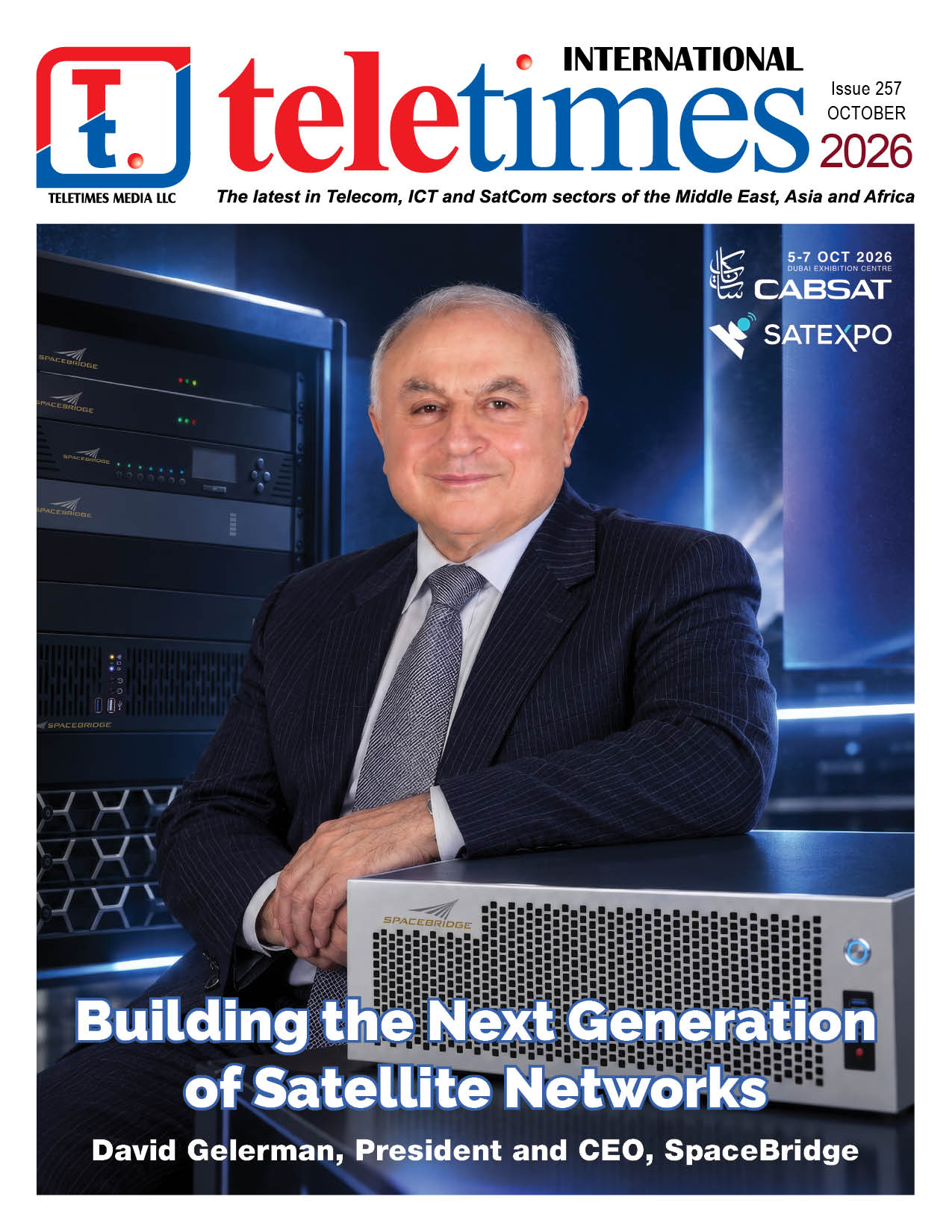

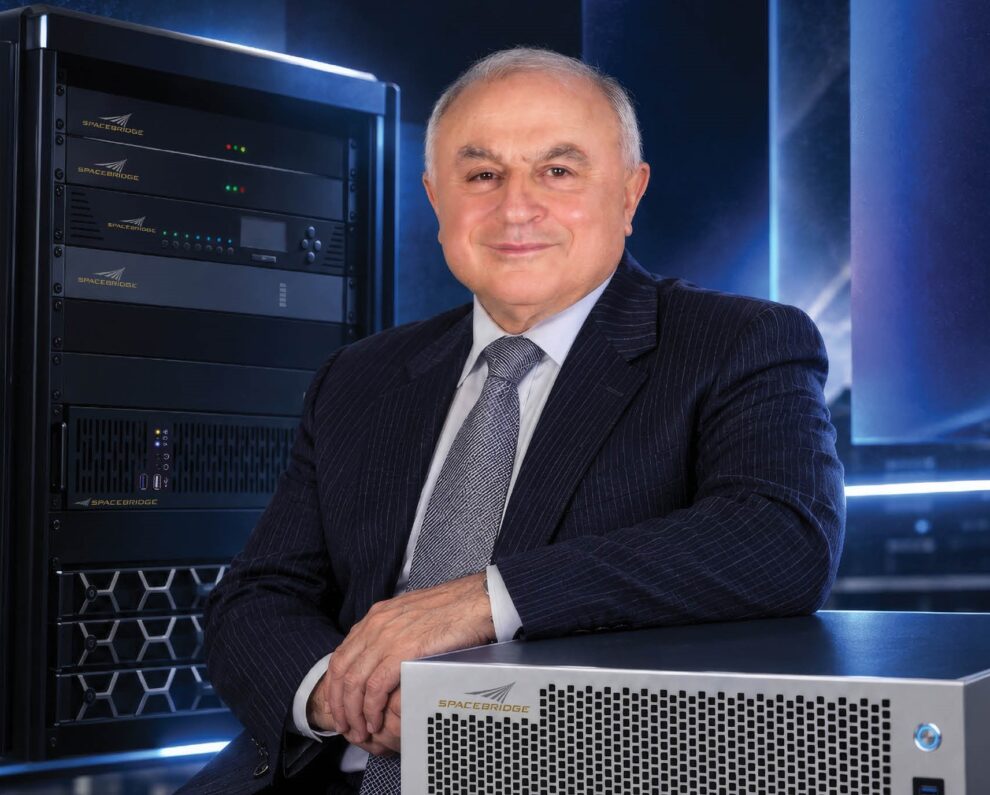

SpaceBridge President and CEO David Gelerman on Flexibility, Resilience and Growth
Interview: Khalid Athar
Khalid Athar: The SatCom market has evolved significantly in recent years, with new constellations, multi-orbit services and closer integration with terrestrial networks. How do you see the market today, and which trends do you expect to have the greatest impact on the industry over the next three years?
David Gelerman: We are entering a period in which satellite communications must deliver greater flexibility, stronger resilience and better economics simultaneously. New constellations have expanded customer expectations and brought greater visibility to our industry. They have also challenged established operators and technology providers to innovate faster and demonstrate the value they deliver.
I see a market with considerable opportunity, but one that increasingly rewards differentiation. Customers are looking closely at the quality, availability and economics of the complete service. For government and enterprise users in particular, the discussion extends well beyond headline download speeds to include committed capacity, security, operational control and long-term continuity.
Over the next three years, I expect three developments to have the greatest impact.
“We are entering a period in which satellite communications must deliver greater flexibility, stronger resilience and better economics simultaneously.”
First, the integration of GEO, MEO and LEO with terrestrial connectivity will become increasingly important. Each orbit brings different strengths, and different applications have different requirements for latency, coverage, capacity and availability. The most effective architectures will match the communications path to the application and provide alternatives when conditions change. GEO will continue to play an important role, particularly where broad coverage, predictable capacity and sovereign network operation are priorities.
Second, the ground segment will become an even greater source of competitive advantage. An operator’s economics depend heavily on how effectively the ground network uses the available satellite resources. Bandwidth allocation, waveform selection, traffic management and adaptation to changing conditions all influence the cost of delivering a dependable service. Improvements in these areas can increase the value of existing satellite assets.
Third, sovereignty and resilience will carry greater weight in purchasing decisions. Customers want to understand who controls their network, where it is managed, how their information is protected and what happens if infrastructure becomes unavailable. For defence and critical infrastructure, these questions are fundamental.
Automation will support all three developments. As networks become more complex, operators will need more effective tools to manage resources and maintain service quality. Our view is that automation must produce measurable benefits while preserving clear operational control. At SpaceBridge, these practical requirements guide our technology strategy.
KA: ESTELLA has now been in the market for more than two years. How has customer adoption progressed, what feedback are you receiving from deployments, and how is that experience shaping the platform’s next phase of development?
DG: ESTELLA platform sales are gaining momentum, with successful deployments and strong customer satisfaction accelerating adoption across regions and applications and expanding its commercial footprint. Customers in the Middle East and Latin America have already deployed multiple hubs and continue to expand their networks, a clear endorsement of ESTELLA’s operational performance and commercial value. Their continued investment demonstrates the confidence the platform earns in the field and its ability to support long-term customer growth.
We have also begun commercial deployments of UniHUB in Brazil and Chile and received new orders for fully redundant ESTELLA hub systems from customers in the Middle East, Europe, Asia and Africa. Together, these developments demonstrate the relevance of the product family across different network sizes, business models and operational requirements.
“The ground segment will become an even greater source of competitive advantage.”
A central theme in customer discussions is the need to combine performance with operational simplicity and affordable growth. Customers want to support demanding applications, use satellite bandwidth competitively and efficiently, and expand their networks while preserving their investment in the underlying infrastructure. They also need the flexibility to accommodate changing traffic patterns without redesigning the network each time a site’s requirements evolve.
The ESTELLA platform addresses these needs through an adaptive architecture. WaveSwitch™, for example, allows terminals to transition dynamically and hitless (no errors or packet loss) between shared TDMA resources and dedicated continuous carriers as traffic requirements change. This enables the same network to serve intermittent traffic and sustained, high-throughput applications efficiently. Dynamic resource assignment gives operators additional flexibility to place capacity where it is needed.
Deployment experience is helping us refine installation tools, configuration, built-in diagnostics suits of tools and network management, alongside improvements in capacity and functionality. These operational details matter greatly to customers managing geographically dispersed sites.
UniHUB extends ESTELLA technology into a compact platform, opening opportunities where space, power, mobility and deployment logistics are important constraints. We see particular value in tactical military applications and distributed hub architectures designed to reduce dependence on a single central location.
Our development direction includes expanded mesh capabilities and coordination among distributed network elements. The objective is greater survivability through alternative communications paths and appropriately distributed control. That resilience must be engineered across the complete system, including power, antennas, satellite resources and management infrastructure.
The next phase of ESTELLA therefore combines higher performance with simpler operations, greater deployment flexibility and stronger communications assurance.
KA: The Middle East and Africa remain important markets for satellite connectivity. Where do you see the strongest growth opportunities across the region today?
DG: We see particularly strong opportunities in government and defence, cellular backhaul, enterprise connectivity and remote industrial operations. We also see considerable potential in satellite-based content distribution, particularly across Africa. These markets have different operational and commercial priorities, and success requires solutions suited to local needs.
In the Middle East, sovereign communications and the protection of critical infrastructure are important areas of opportunity. Government and defence users need networks that they can control, secure and adapt to their missions. Energy companies, maritime operators and transportation organisations also require dependable connectivity across remote areas and moving platforms.
For these customers, service continuity can have direct operational consequences. The communications system must support essential applications, prioritise critical traffic and remain manageable when conditions become difficult. This creates demand for resilient architectures, flexible capacity allocation and close integration between satellite and terrestrial networks.
Across Africa, we see substantial opportunity in extending mobile coverage and connecting businesses, public services and communities beyond the practical reach of terrestrial infrastructure. Satellite can also provide valuable backup connectivity where terrestrial routes are vulnerable to disruption.
Another important opportunity is receive-only content distribution using the new DVB-NIP standard, known as DVB Native IP. This approach enables the efficient satellite delivery of IP-based content to widely dispersed receiving locations. Educational materials, training programmes, television and video, software updates and public information can be distributed to many sites simultaneously, without requiring a separate satellite transmission for each recipient.
For Africa, this offers a compelling model for reaching schools, community centres, businesses and remote settlements. Content can be received at a local distribution point, stored where appropriate and made available to users over Wi-Fi or a local network. The satellite receiving terminal does not require an RF transmit chain for this one-way service, helping reduce equipment complexity, power requirements and deployment costs.
The economic advantage is especially attractive when many locations need the same content. A common satellite transmission can serve receiving sites throughout the coverage area, allowing the distribution cost per site to decrease as adoption grows. Where interactive services are required, a complementary return connection can be provided through an available terrestrial or satellite network. We see DVB-NIP as a valuable opportunity to complement broadband connectivity with efficient, large-scale content delivery.
Mining, energy, agriculture and transportation offer further opportunities. A remote operation may need business systems, monitoring, voice, video and staff connectivity on the same network. These applications have different traffic characteristics and priorities, making efficient resource management particularly valuable.
The challenge across all these applications is to make services commercially sustainable. Equipment cost is only one part of the equation. Satellite capacity, power, installation, maintenance, technical support and future expansion all contribute to the total cost of ownership. An installation that is inexpensive initially can become costly if it uses bandwidth inefficiently or requires frequent intervention.
SpaceBridge’s opportunity is to improve that overall equation through greater spectral efficiency, adaptive bandwidth allocation, compact infrastructure and distribution architectures suited to the application. Regional partnerships, local installation capability, training and responsive support are equally important. Our objective is to help operators build networks and services that remain competitive as their markets develop. Scalable deployment also allows investment to follow demand.
Regional partnerships are essential to this approach. Local knowledge, installation capability, training and responsive support help turn a sound technical design into a successful long-term service. We want to give operators the tools and support to build networks that remain competitive as their markets develop.

KA: Multi-orbit networks, 5G NTN and software-defined infrastructure are increasingly reshaping SatCom. How is SpaceBridge positioning itself within this evolving ecosystem?
DG: Our approach begins with architectural flexibility and investment protection. Satellite and ground infrastructure represent long-term commitments. Customers need confidence that the systems they purchase can evolve as services, network architectures and standards change.
For SpaceBridge, this means developing adaptable modem and ground-network technology and ensuring that it can work effectively within a broader communications ecosystem. ESTELLA and UniHUB provide a foundation through dynamic bandwidth allocation, flexible waveform operation and network resource management. These capabilities allow the ground segment to respond to changing service requirements.
Multi-orbit networking adds another level of complexity. Antennas, RF equipment, modems, gateways, routing and service management must operate together. A successful solution needs to address coverage transitions, changing link conditions, differences in latency and the continuity of user applications.
We therefore approach multi-orbit development at the system level, combining our own expertise with that of ecosystem partners. SpaceBridge brings decades of satellite ground-segment expertise and a proven record of innovation to this evolving ecosystem. With ESTELLA, UniHUB and our proprietary WaveSwitch™ technology, we have translated advanced engineering into commercially deployed platforms that give operators greater flexibility, efficient use of satellite capacity and control over their networks. We are building on these achievements to help shape the next generation of integrated satellite communications, working with ecosystem partners to advance performance, interoperability and resilience across the complete architecture.
We also see 5G NTN as an important direction for closer integration between satellite and mobile networks. There are different opportunities within that evolution, including satellite backhaul and more direct integration of satellite access into mobile service architectures. Each has its own technical and commercial requirements.
Our focus is on where SpaceBridge can contribute meaningful value through waveform efficiency, modem performance, resource management and interoperability. Standards are important, but customers also need workable terminal economics, dependable performance and manageable deployment complexity.
Software-defined infrastructure supports this evolution by making it easier to change services and introduce capabilities throughout the equipment’s useful life. At the same time, high-performance communications still depend on the quality of the underlying processing and RF design. Our approach combines adaptable software with hardware engineered for demanding communications workloads.
“Ultimately, we measure progress through customer outcomes: more effective use of capacity, faster service changes, simpler operations and greater freedom to evolve the network.”
Ultimately, we measure progress through customer outcomes: more effective use of capacity, faster service changes, simpler operations and greater freedom to evolve the network.
KA: As operators look for greater flexibility and efficiency from their ground infrastructure, how are customer requirements changing, and how is SpaceBridge responding?
DG: Customers increasingly evaluate the performance and economics of the complete operational network. Peak throughput is important, but it is only one part of the assessment. Operators also want to know how much satellite capacity is required to deliver the service, how the network behaves under load, how critical traffic is protected and what it will cost to expand.
Traffic patterns are becoming more diverse. One site may generate small amounts of intermittent data, while another requires sustained capacity for enterprise applications or video. Requirements can also change over the course of a day. A network that allocates resources too rigidly can leave capacity underused in one area while another site is constrained.
SpaceBridge addresses this through adaptive resource management. The ESTELLA platform combines shared access with dynamically assigned continuous carriers, allowing the network to serve different traffic profiles within a common architecture. Our proprietary WaveSwitch™ technology adds flexibility and enables dynamic, on-the-fly transitions between shared TDMA resources and dedicated continuous carriers as traffic demand changes, optimising satellite capacity utilisation while maintaining the required quality of service.
Our objective is to maximise usable network capacity while preserving the quality of service customers depend on. By allocating resources dynamically and prioritising critical traffic, we help operators meet their service commitments and sustain essential applications, even when bandwidth is constrained or link conditions deteriorate.
Customers also want greater control over their growth. They may begin with a relatively small deployment, add sites gradually and later introduce higher-capacity services. Scalable platforms and modular expansion help align capital expenditure with actual demand and reduce the disruption associated with growth.
UniHUB delivers powerful networking capabilities at an affordable cost, combining a compact design with simplified installation and reduced deployment expenses. Its small footprint and low power requirements make it particularly well suited to remote facilities, compact shelters and tactical environments, where space, weight and energy availability are critical constraints. By bringing ESTELLA technology into a practical, easily deployable platform, UniHUB makes advanced satellite networking accessible wherever it is needed.
Security and resilience are equally central. Customers need trusted access, protected information, secure management and redundancy appropriate to their mission. They also want to operate their networks under their own authority, with clear end-to-end visibility into performance and resource use.
We address these requirements through an integrated approach, combining efficient waveforms, robust network design, straightforward management and dependable support. Our aim is to deliver technology that provides measurable value from day one and increases that value over time through expanded capabilities, improved efficiency and the flexibility to support new services throughout the network’s operational life.
KA: Looking beyond the Middle East, what are SpaceBridge’s key priorities for the coming year, and what can the industry expect next from the company?
DG: Our first priority is to translate our recent technical progress and commercial momentum into a broader base of successful operational networks. We see opportunities across North America, Latin America, Asia, Africa, PacRim and Europe, particularly in defence, government, enterprise communications and telecommunications infrastructure.
The expansion of existing customer networks is an important part of that strategy. When a customer adds hubs, terminals or services, it creates opportunities to deepen the relationship and demonstrate the scalability of our technology. We intend to build on these competitive advantages by expanding our market presence and strengthening regional sales, integration and support partnerships to accelerate adoption and deliver lasting value to our customers.
On the product side, we continue developing the ESTELLA and UniHUB platform, with emphasis on capacity, efficiency, mesh networking, operational simplicity and resilience.
Mesh is especially important for applications that require frequent communication between remote locations. Direct terminal-to-terminal connectivity can avoid routing that traffic through a central hub for retransmission, improving latency and reducing the satellite resources required for those exchanges. Combining star and mesh capabilities gives network designers more flexibility to support different applications within the same overall system.
We see significant opportunities for distributed hub architectures in tactical and mission-critical applications, including disaster recovery and military communications. By supporting mobility, geographic dispersion and alternative communications paths, these architectures can reduce dependence on a single hub location and maintain essential services when individual network elements become unavailable.
Higher-capacity modem technology remains another development priority. As customers adopt wider satellite channels and increasingly demanding applications, we are focused on delivering the processing power, spectral efficiency and cost-effectiveness needed to translate that capacity into higher usable throughput, competitive services and stronger returns on infrastructure investment.
In parallel, we intend to build on our return to the RF business. Bringing modem, networking and RF expertise together allows us to address more of the complete communications chain and optimise the interaction between its components.
“The industry can expect SpaceBridge to continue delivering practical engineering innovation, with a clear focus on efficient, resilient and customer-controlled communications.”
Execution remains central to all these priorities. We support our technology with reliable manufacturing, efficient deployment, comprehensive customer training on our new suite of diagnostic and performance KPI tools, and responsive technical assistance. These tools help customers monitor network health, assess performance and resolve issues efficiently.
We earn lasting customer confidence by delivering high-performance, cost-effective solutions backed by responsive support and an organisation that stands firmly behind its commitments. This is the foundation of our long-term partnerships and shared success.
The industry can expect SpaceBridge to continue delivering practical engineering innovation, with a clear focus on efficient, resilient and customer-controlled communications. Our ambition is to help operators build networks that perform well today and retain the flexibility to meet tomorrow’s requirements.