
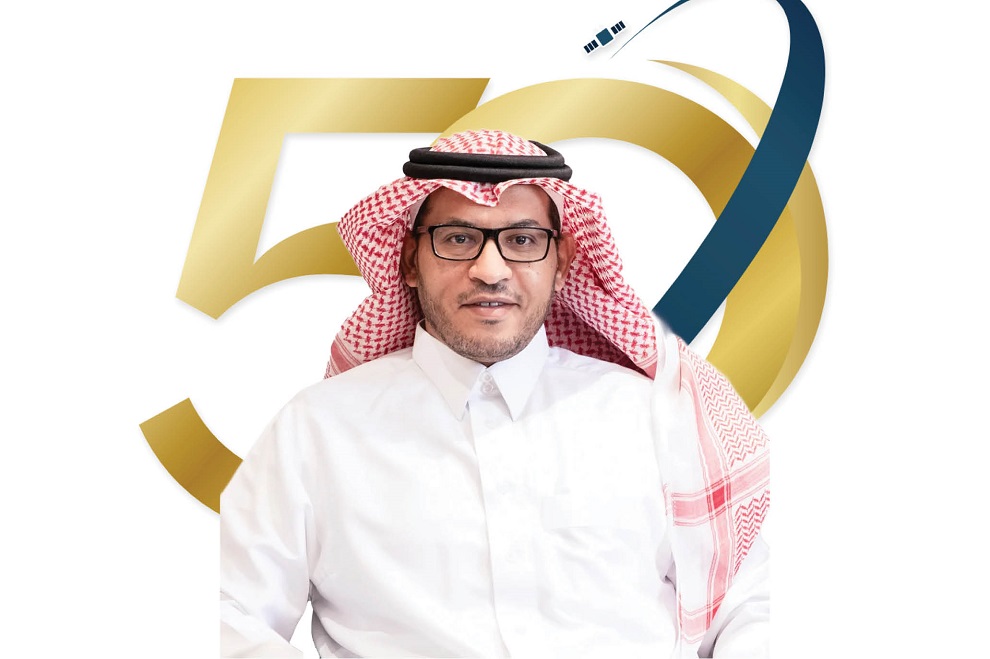

Dr. Badr Alsuwaidan, CEO of Arabsat
Exclusive Interview with Teletimes
Founded in 1976 as an initiative of 21 Arab countries, Arabsat has developed into one of the region’s leading satellite communications organizations. Today, its services span broadcasting, telecommunications, broadband, advanced data networks and satellite ecosystem services, reaching customers across the Middle East, Africa, Europe and Central Asia. Arabsat says its services reach tens of millions of households in more than 100 countries.
As Arabsat approaches its 50th anniversary, we spoke with the company about its evolution over five decades, the changing satellite communications landscape, the emergence of LEO and 5G, and the growing role of artificial intelligence.
Q1: As Arabsat approaches its 50th anniversary, which achievements are you particularly proud of, and what does this milestone mean for the organization?
Badr Alsuwaidan: Arabsat started as an initiative of the Arab League and its leaders to provide Arab countries and the wider region with satellite, telecommunications and broadcasting services. That was the vision they had, and Arabsat has successfully worked towards achieving it over the past five decades.
During that time, Arabsat managed to scale and diversify its services through different partnerships and by providing the latest satellite technologies. At one point, we reached 10 satellites in the region, providing a constellation that offered different frequencies and services, from HTS to broadcasting and BSS services.
Arabsat has helped the region advance in space and telecommunications while supporting countries in scaling their infrastructure. We continue to play that role through different technologies and approaches, while keeping pace with and anticipating emerging technology requirements. Arabsat is working hard to meet those needs and provide the region with the latest technologies.
Q2: How has Arabsat evolved over the past five decades, particularly as the satellite market itself has changed?
BA: Arabsat has provided private networks for countries as well as television broadcasting services, and we have seen and supported the expansion of satellite media over the past two decades.
Today, Arabsat is also moving into HTS, providing high-throughput technology to individual countries. We have introduced Ka-band services in markets including Sudan and Libya, while also providing a wide range of services across the GCC, including Saudi Arabia and other GCC countries.
This has helped not only Arabsat but also other organizations and local companies to scale. One example is OmanSat. We work closely with local companies and telecommunications operators to improve the use and benefits of satellite technology within individual countries and integrate it with their telecommunications infrastructure, serving both defense requirements and commercial services.
Q3: LEO constellations, multi-orbit services and 5G NTN are reshaping satellite communications. How is Arabsat responding to these developments?
BA: Arabsat is already providing a range of services supporting 5G and integrated connectivity. LEO represents a new market, and Arabsat is working with some LEO operators, providing these capabilities as part of integrated solutions based on customer requirements.
LEO is a new technology that brings advantages and new services, but it also comes with challenges and limitations. Regulations across the region are still adapting to LEO. Arabsat therefore continues to provide solutions that fit the regulatory environment within the region while meeting the requirements that Arab countries expect from us.
Q4: Who are Arabsat’s main telecommunications partners for 5G-related services?
BA: We work with all the major telecommunications operators in the region. In Saudi Arabia, for example, we work with all three operators: stc, Mobily and Zain. In Sudan, we work with Sudatel, and in Libya with LTT.
These relationships form part of the services Arabsat provides to telecommunications operators, many of which are part of our wider network and partnership ecosystem.
Q5: Looking ahead to the next decade, what are Arabsat’s main priorities, and how do you see the satellite market evolving?
BA: The satellite market is expanding to include different layers of customers, including enterprises and new customers that are increasingly looking for satellite services.
Arabsat is adapting by moving beyond simply providing capacity or individual services. We are increasingly providing solutions and tailored services so that our customers do not necessarily have to build and invest in their own ground infrastructure and private networks.
At Arabsat, we are providing more managed services and solutions tailored to the needs of our clients and individual countries. Requirements vary considerably from one country to another.
Our region is MENA, and Arabsat is mandated through its ownership by Arab League countries. We therefore provide solutions that meet the requirements and needs of each country, taking into consideration its existing infrastructure as well as the support and ecosystem available for us to work with.
Q6: How is AI affecting Arabsat’s business, and how are you applying it across your operations and services?
BA: Telecommunications, IT and other services are becoming increasingly integrated. We are therefore seeing integrated solutions that combine telecommunications, IT and AI. AI provides tools that can help infrastructure and enable us to get more from the solutions and networks we operate.
Like any new technology, AI comes with significant advantages, although there is also some hesitation among certain customers regarding its use. We see considerable potential in using AI to help us maximize the value of our services and provide better solutions.
AI can help make solutions more integrated and dynamic by understanding changing requirements and enabling networks to respond accordingly. We are already investing in the technology to understand, first, how we can use AI to derive greater value from our own assets and, secondly, how our customers can benefit from the technology we provide.
This includes looking at how bandwidth and resources can be managed dynamically across our infrastructure and our clients’ resources to maximize the benefits of the overall system. Ultimately, this can lead to better services and reduced costs for the customer.