

Second term priorities include expanding digital opportunity, advancing secure and resilient innovation, and ensuring ITU remains future-ready
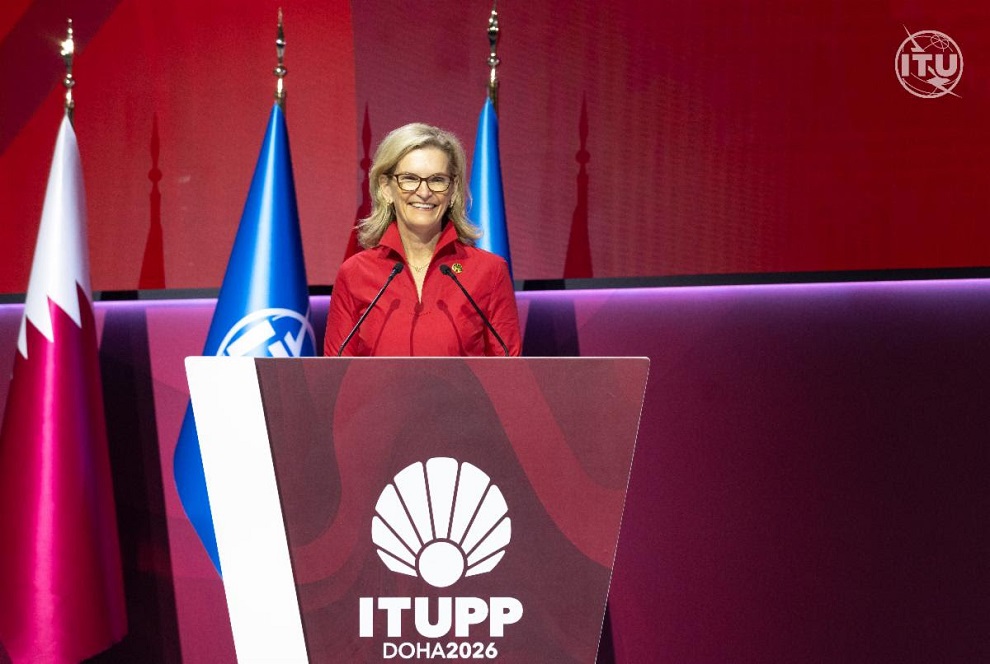
Member States of the International Telecommunication Union (ITU) today re-elected Doreen Bogdan-Martin of the United States as the organization’s Secretary-General.
Bogdan-Martin won re-election to lead the UN agency for digital technologies with 164 votes out of 173 votes cast.
The election took place during the Plenipotentiary Conference 2026 (PP-26) in Doha, Qatar, as ITU elects the management team to oversee its strategy and budget over the next four years.
“I am deeply honoured for the trust ITU Member States have placed in me to serve a second term as Secretary-General of the International Telecommunication Union,” said Bogdan-Martin, who was first elected ITU Secretary General in 2022. “The digital world has changed dramatically in four years, and it will change even faster going forward. Our job is to make sure that change works for everyone, especially the 2 billion who are unconnected. Together, we can make sure the digital future leaves no one behind.”
Driving digital progress, strengthening ITU
Bogdan-Martin has more than three decades of experience in international telecommunications policy and has held a series of leadership positions at ITU. She took office as ITU Secretary-General in 2023 after a term as Director of ITU’s Telecommunication Development Bureau from 2018 to 2022. She is the first woman to serve in both elected positions.
Under Bogdan-Martin’s leadership, ITU has advanced its goals of universal connectivity and sustainable digital transformation in a period of rapid transformation with the advance of AI, the expansion of space-based telecommunications services, and an increasing need to strengthen the resilience of digital systems.
In Bogdan-Martin’s first term, ITU’s Partner2Connect Digital Coalition surpassed USD 120 billion in commitments to support global connectivity. Bogdan-Martin has also deepened ITU’s base of engagement, bringing in new members for a total that now exceeds 1,000 companies, universities, research institutes and civil society organizations alongside ITU’s 194 Member States.
In this time, ITU also launched a comprehensive transformation programme to modernize its systems and processes while increasing organizational effectiveness.
From connectivity to opportunity
Bogdan-Martin’s second-term priorities include focus on connecting the 2 billion people around the world that remain offline while ensuring that emerging technologies such as AI create new opportunities for everyone. Furthermore, strengthening digital resilience, promoting cybersecurity and expanding digital skills feature prominently in her second term priorities.
Within ITU, Bogdan-Martin has pledged to continue the organization’s transformation to make it more agile, transparent and responsive to the needs of its membership.
Electing ITU’s other top leaders
The Plenipotentiary Conference is ITU’s highest decision-making conference.
At PP-26, Member States will also elect ITU’s Deputy Secretary-General, Radiocommunication Bureau Director, Telecommunication Standardization Bureau Director, and Telecommunication Development Bureau Director.
The voting for ITU’s senior leadership will be followed by elections for the 12-member Radio Regulations Board and for regionally allocated Member State places on the 48-seat ITU Council, which governs ITU between Plenipotentiary Conferences.
In addition to leadership elections, the conference will set ITU’s financial and strategic plans. PP-26 takes place through 27 November at the Doha Exhibition and Convention Center.