
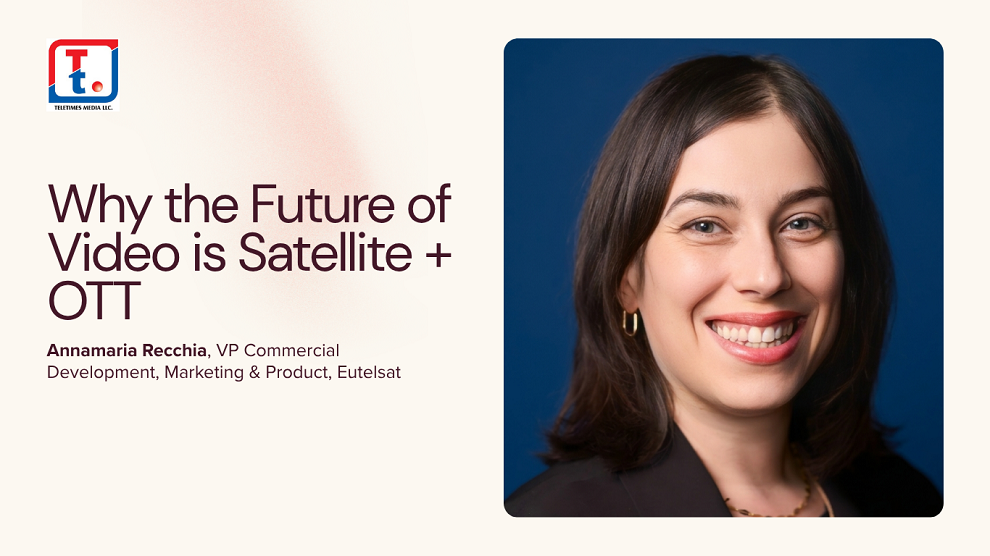

Annamaria Recchia, VP Commercial Development, Marketing & Product, discusses how hybrid satellite-OTT architectures, GEO-LEO integration, and IP-native broadcasting are reshaping the future of video distribution.
Satellite vs OTT Evolution
“I think that the ‘satellite vs OTT’ mindset no longer reflects the current market reality. At Eutelsat we believe in a “satellite + OTT” hybrid model. The real question is not how satellite competes with OTT, but rather how satellite amplifies OTT. Broadcasters now have multilayered distribution strategies to optimize their channel delivery, enabling them to get the best from this hybrid broadcast-OTT world.
“The real question is not how satellite competes with OTT, but how satellite amplifies OTT.”
Satellite is unique in delivering broadcast efficiency at scale, without CDN costs that increase as audiences grow. For broadcasters distributing content to tens of millions of homes, particularly live and high-quality content, that economic model is irreplaceable – and it’s here to stay. Over the past few years, we have been reshaping the place of satellite into a smarter part of the OTT stack. Through new standards such as DVB-NIP, HbbTV, and our hybrid distribution model, broadcasters can use satellite for the heavy lifting, ensuring mass distribution to wider audiences, with no risk of latency or quality issues from internet congestion at peak demand times; while using broadband return paths, where available, for interactivity, personalisation and analytics. The two work in tandem. That’s where the value chain is heading.”
Hybrid GEO-LEO Strategy
“Our multi-orbit strategy is genuinely differentiated. Eutelsat is the first fully integrated GEO-LEO satellite operator, with a fleet of 31 geostationary (GEO) satellites located at key orbital positions and more than 600 Low Earth Obit (LEO) satellites in a pole-to-pole constellation, delivering unique opportunities for customers around the world.
For video specifically, GEO remains the gold standard for broadcast distribution: wide beams, high throughput, proven reliability. But LEO opens up entirely new possibilities for contribution links, live event coverage from remote locations and low-latency interactive applications. Think about live sports production (natively IP) from a stadium in a rural area, or news gathering in a conflict zone: LEO significantly reduces the friction and cost of getting that signal back to the studio, seamlessly integrating it into their remote production stack. We are happy to be ready now to offer Eutelsat’s OneWeb-based Video solutions to our customers and are already seeing significant interest.”
“Through our hybrid satellite and FAST channel distribution model, channels can unlock dual revenue streams”
Monetization & New Revenue Models
“We’re actively building the infrastructure for the next generation of video monetization, and FAST channels are a perfect example of how satellite fits into the business case.
Through our hybrid satellite and FAST channel distribution model, channels can unlock dual revenue streams: leveraging CPM-based ad-monetization for the streaming part, while maintaining traditional advertising revenue models via satellite, thus maximizing overall potential across platforms.
Our partnership with wedotv is a great example: by using HbbTV technology, wedotv can enable dynamic ad-insertion on channels distributed via our HOTBIRD satellites. Combining the massive reach of these satellites, with the targetability of digital advertising, they can reach a larger audience of connected TVs throughout Europe and the MENA region, as well as a new audience of non-connected TV viewers. That’s a genuinely new business model that we have been pursuing over the past couple of years.
Beyond FAST, we’re also looking at IP-based broadcasting and edge-caching as key levers. DVB-NIP enables push-based VOD delivery via satellite: content is cached locally on a gateway device, reducing the broadband load for on-demand viewing while maintaining satellite’s distribution efficiency in delivering a high-quality user experience. For broadcasters and also streamers in markets where broadband remains unaffordable, this is transformative.”
Bridging the Digital Divide
“This is where satellite’s public service mission and commercial opportunity genuinely converge. GEO satellites are essential for digital inclusion, ensuring access to linear and non-linear content where terrestrial broadband is limited or missing; satellites also connect rural and hard-to-reach areas where fiber deployment is costly or impractical, ensuring universal coverage.
In education, we’re seeing real traction: satellite-delivered content for distance learning, particularly in the Americas, Sub-Saharan Africa and MENA, where we can reach schools that are simply beyond the reach of any ground infrastructure. In public services, emergency broadcasting and governmental communication in times of crisis, rely on satellite as the only truly resilient last-mile option.
What’s changed is that we’re now able to layer interactivity on top of these services through hybrid connectivity. For example, a student in a remote village can watch a lesson delivered via satellite and use a low-bandwidth return path to submit work or access supplementary content. This changes the educational use case fundamentally.”
Innovation in Video Technologies
“We’re very actively involved in the DVB standards evolution and I think our participation at DVB World 2026 signals clearly where we’re heading. Our latest implementations ensure seamless satellite distribution of IP-native OTT streams, push-file based VOD and AVOD via local gateway storage and hybrid DVB-I service lists that merge OTT services with traditional broadcasting services.
What this means in practice is that a single satellite transmission can now serve a fully connected Smart TV with an interactive, multiscreen-ready experience and, simultaneously, serve a basic DTH receiver with a traditional linear channel. One infrastructure, multiple user experiences. For broadcasters, that’s a significant simplification of their distribution architecture.
Future of Video Distribution (2026–2030)
“A few convictions shape how I think about the next five years and beyond.
First, IP-native broadcasting will become the new norm, not the exception. The industry is converging on common standards and satellite will be a first-class citizen in those workflows, not an afterthought. We’re working hard to make sure this happens.
“The economics and reliability of delivering a live event simultaneously to 50 million homes via satellite are simply not replicable over IP at scale today.”
Second, live content, and particularly live sports, will remain satellite’s strongest card. The economics and reliability of delivering a live event simultaneously to 50 million homes via satellite are simply not replicable over IP at scale today and the gap will narrow, but not close by 2030.
Finally, satellite distribution is here to stay. Our challenge over the next 5 years is to adapt our value proposition fast enough to stay central to broadcasters’ distribution thinking as they modernise their technology stacks. This is what makes it so exciting. By reimagining video distribution solutions that combine the coverage, resilience and efficiency of satellite with the interactivity and personalisation of IP, we can define a future where global reach, high-quality delivery and digital innovation coexist seamlessly in a symbiotic way for everyone.”