
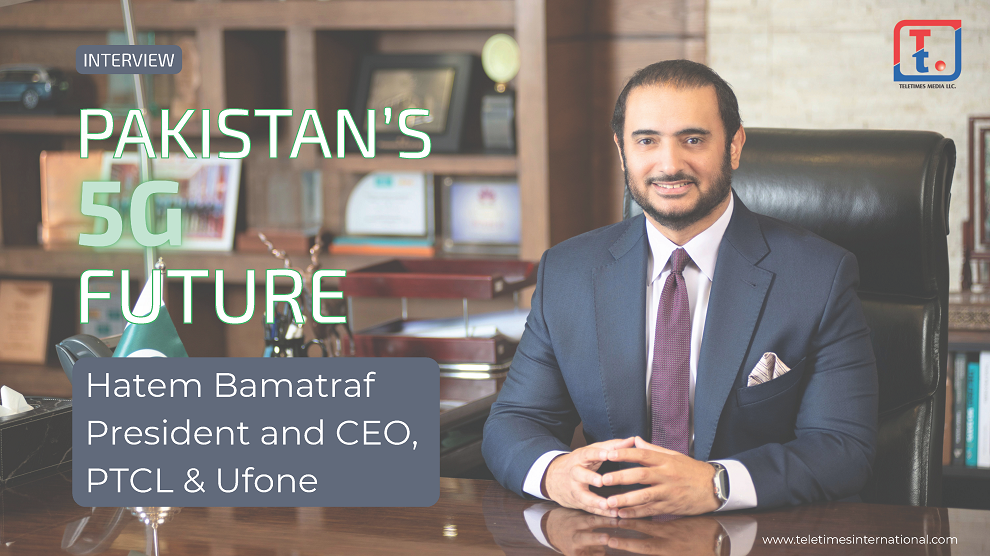

Hatem Bamatraf on PTCL Group’s vision for next-generation connectivity and digital transformation
Exclusive Interview: Khalid Athar
Khalid Athar: Pakistan has finally entered the 5G era. From your perspective, what does this milestone mean for the country’s digital future?
Hatem Bamatraf: The arrival of 5G is more than a technology upgrade. It marks the beginning of a new phase in Pakistan’s digital development where connectivity becomes a platform for innovation across the entire economy.
For years, telecom networks have primarily supported communication and mobile broadband. With 5G, they evolve into intelligent digital infrastructure capable of powering new industries, enabling automation, and supporting real-time services across sectors such as healthcare, manufacturing, logistics, and public services.
In many ways, 5G is not just about faster connectivity. It is about building the digital foundation on which Pakistan’s next generation of innovation and economic growth will be built.
“We intend to build a resilient digital infrastructure that can support Pakistan’s rapidly evolving digital economy for many years to come”
KA: Ufone acquired a significant portion of spectrum in the recent auction. How does this strengthen PTCL’s long-term connectivity strategy?
HB: Well, Spectrum is the backbone of every mobile network, and acquiring additional capacity is an important step in preparing for the next generation of digital services.
We adopted an aggressive 5G acquisition strategy for Ufone. We secured the largest portion, i.e. 120 MHz of the 3.5GHz frequency band, which is the global standard of 5G. This strengthens Ufone’s ability to enhance network capacity, deliver better customer experiences, and support the advanced capabilities required for high-performance 5G deployments.
For us, however, the bigger picture is about integration. When Ufone’s mobile network is combined with PTCL’s nationwide fiber infrastructure, it creates a powerful connectivity platform capable of supporting both consumer demand and enterprise innovation. The integration of Telenor Pakistan, which is expected soon, subject to regulatory approvals, will further strengthen this capability.
Our objective is simple, we intend to build a resilient digital infrastructure that can support Pakistan’s rapidly evolving digital economy for many years to come.
“When Ufone’s mobile network is combined with PTCL’s nationwide fiber infrastructure, it creates a powerful connectivity platform capable of supporting both consumer demand and enterprise innovation. The integration of Telenor Pakistan, which is expected soon, subject to regulatory approvals, will further strengthen this capability“
KA: Beyond faster mobile broadband, what new opportunities do you believe 5G will unlock for businesses and industries in Pakistan?
HB: The real impact of 5G will be felt in how it enables industries to operate differently.
With ultra-low latency and massive device connectivity, businesses can deploy intelligent systems that automate operations, improve efficiency, and generate real-time insights. This opens up possibilities for industrial IoT, connected logistics networks, smart city infrastructure, and advanced healthcare applications.
We also see significant potential in digital education, remote healthcare services, and enterprise-grade connectivity solutions that can help organizations operate more efficiently in an increasingly digital environment.
Ultimately, 5G expands the role of telecom networks from enabling communication to enabling innovation across the entire economy.
KA: The integration of Ufone and Telenor Pakistan is one of the most significant developments in the telecom sector. What strategic value does this bring to the market?
HB: The integration represents a major opportunity to strengthen Pakistan’s connectivity ecosystem. Once fully integrated, the Ufone-Telenor Pakistan MergeCo will hold the largest spectrum in the country across low, medium and highest frequency bands to bring 5G connectivity to rural and semi urban regions at par with big cities.
By bringing together complementary spectrum assets, network infrastructure, and operational expertise, we are creating a platform with greater scale, resilience, and investment capacity. This allows us to enhance coverage, improve service quality, and deliver stronger network performance for millions of customers.

Importantly, it also enables us to accelerate investments in next-generation technologies and digital services.
When infrastructure, spectrum, and capabilities are combined thoughtfully, the entire ecosystem benefits, customers receive better services, and the industry gains the scale needed to invest in future technologies.
KA: With the combined entity expected to serve more than 70 million customers, how will Ufone position itself in this new phase of industry competition?
HB: Scale alone does not create leadership. What matters is how that scale is used to deliver better experiences and more innovative services for customers.
Our strategy is centered on convergence. PTCL’s extensive fiber infrastructure combined with the future Ufone – Telenor Pakistan MergeCo’s nationwide 5G network and connectivity capabilities gives us a unique foundation to deliver integrated connectivity solutions that go beyond traditional telecom services.
We are also expanding our focus toward digital platforms, enterprise solutions, and services that support Pakistan’s growing digital economy.
Our ambition is not simply to grow in size, but to become a more capable digital operator that can enable innovation for individuals, businesses, and institutions across the country.
KA: Looking ahead, how do you see the telecom industry evolving over the next five years as Pakistan transitions into the 5G era?
HB: The telecom industry is moving toward a model where connectivity, cloud platforms, and digital services operate as a unified ecosystem.
As technologies such as 5G mature, networks will increasingly support applications that require extremely high reliability, low latency, and seamless integration with digital platforms. This will expand the role of telecom operators from connectivity providers to digital enablers.
“Being part of e& provides us with access to global expertise, advanced technological capabilities, and valuable experience in managing large-scale digital transformation initiatives across multiple markets”
We will also see stronger convergence between fixed networks, mobile infrastructure, and digital platforms.
In the coming years, the companies that succeed will be those that build integrated digital ecosystems rather than simply offering connectivity services.
KA: PTCL is part of one of the world’s leading telecom groups, e&. How does this global backing support your ambitions for Pakistan’s digital future?
HB: Being part of e& provides us with access to global expertise, advanced technological capabilities, and valuable experience in managing large-scale digital transformation initiatives across multiple markets.
This allows us to bring global best practices into Pakistan’s telecom ecosystem while adapting them to the country’s specific needs.
At the same time, our focus remains firmly on building infrastructure and digital platforms that support Pakistan’s long-term economic and technological progress.
Our commitment is to combine global experience with local ambition to help accelerate Pakistan’s digital transformation.