




Dr Nasrullah K. Khilji
A systematic review of the literature clearly demonstrates that technological innovations are playing a pivotal role in enhancing performance within Business Process Management (BPM). In today’s digital era, the way businesses operate has undergone a profound transformation, one that necessitates a complete rethinking and redesign of core processes and operations. BPM itself has evolved – moving away from rigid , linear workflows toward dynamic, intelligent systems. This shift has been driven largely by the integration of Business Intelligence Systems (BIS) and a wave of Digital Technological Innovations (DTI).
Emerging technologies such as Artificial Intelligence (AI), machine learning (ML), cloud computing, big data analytics, and even immersive technologies are redefining BPM. The focus has shifted decisively toward creating value, engaging customers more effectively, and managing increasingly complex, human-centric processes. This article explores how technological innovation serves as a strategic driver of upgrades within BPM frameworks, reshaping industries and redefining competitive advantage.
Human – Machine Collaboration: A New BPM Paradigm
At the forefront of this transformation is the convergence of human and machine intelligence. This integration is crucial for developing advanced cognitive capabilities within organisational processes. Today’s BPM is no longer simply about automating tasks or optimising workflows; it’s about enabling secure communication, leveraging big data analytics, applying cryptographic security where necessary, and building integrated information systems that support decision-making in real time.
The rise of Industry 5.0 further underscores this trend. Building upon the automation and digitisation milestones of Industry 4.0, Industry 5.0 emphasises human-machine collaboration and sustainable development. It champions the deployment of AI, Augmented Reality (AR), Big Data Analytics (BDA), and BIS to create business ecosystems that are more efficient, resilient, and sustainable.
The Case for Innovation in Project and Operations Management
In industries such as engineering, aviation, healthcare, and manufacturing; where precision, timeliness, and technological integration are critical; innovative project management (PM) and efficient Operations Management solutions have become strategic imperatives. AI and data science are transforming PM practices, helping organisations enhance project effectiveness and operational efficiency while to boost competitiveness.
AI enables systems to learn from data, optimise performance, and adapt to dynamic conditions. Meanwhile, Augmented Reality (AR) and Virtual Reality (VR) are creating immersive environments that aid process navigation, training, and decision-making in
complex scenarios. Organisations that integrate these innovations into their PM frameworks report not only improved outcomes but also higher employee engagement and customer satisfaction.
Digital transformation in project and operations management has accelerated dramatically, as organisations leverage advanced data analytics, automation, and predictive modelling to revolutionise traditional approaches. However, the path to transformation is not without its challenges for instance rational acceptances, implementation hurdles, cultural resistance, and ethical considerations need to be carefully managed.
The Evolution of BPM: From Workflow to Intelligent Systems
Introduced in the early 1990s as an evolution beyond simple workflow and planning practices, BPM has since expanded into a multifaceted management discipline. Today, BPM encompasses workflow management (WFM), operations management (OM), case handling (CH), enterprise application integration (EAI), project portfolio management (PPM), enterprise resource planning (ERP), team dynamics and leadership (TDL), and customer relationship management (CRM), among others. A review of the literature underscores that BPM is more than just a set of operational tools; it is a strategic framework that integrates technological advances with human expertise to create business value.
Digital technologies have propelled BPM forward by transforming it into an adaptive, intelligent practice that is explorative and data-driven rather than static and rule-bound. From a theoretical standpoint, BPM has become a critical enabler of enterprise-wide decision- making. In recent times, organisations increasingly leverage BIS and DTI to align artificial and human intelligence in ways that maximise efficiency, responsiveness, and innovation.
Digital Transformation: Redefining Industry Norms
One of the most significant developments in BPM is the role of digital transformation (DT); the integration of digital technologies into business processes to seamlessly coordinate products and services across organisational and geographic boundaries. In both the private and public sectors, data analytics and digital platforms are being used to enhance sustainability and improve employability outcomes.
Digital artefacts and infrastructures are redefining industry norms and enabling entirely new forms of value creation. These developments mark the dawn of the Industry 5.0 and smart manufacturing eras. Here, intelligent, connected, and human-centric operations replace traditional mass production. Manufacturers, for instance, are transitioning to digitally enhanced service offerings that prioritise customer experience and ongoing support, a shift that demands cultural as well as technological change.
BIS and Big Data: The Backbone of Modern BPM
Business Intelligence Systems are now indispensable to BPM, enabling organisations to collect, analyse, and act on vast quantities of data from diverse sources. BIS integrates internal systems, external databases, and even online platforms to consolidate information in centralised repositories for real-time decision-making. These capabilities have fuelled the rise of platform-based ecosystems that are reshaping traditional value networks.
As businesses adopt a more digital lens, they are increasingly adapting their business models to harness continuous streams of data for strategic advantage. By integrating insights from multiple disciplines, organisations are achieving a more holistic understanding of their operations and competitive landscape. Digital business models have already transformed sectors like aviation, manufacturing, and retail, while industries such as banking and entertainment are catching up to the technological curve.
Strategic Benefits of Digital Transformation in BPM Contemporary businesses that embrace comprehensive digital strategies report substantial improvements in efficiency, agility, and competitiveness. This strategic alignment strengthens market reputation and supports long-term growth. A systematic review of recent research suggests that organisations prioritising DTI as a core element of their strategy are better positioned to outperform competitors and maintain a strong market presence.
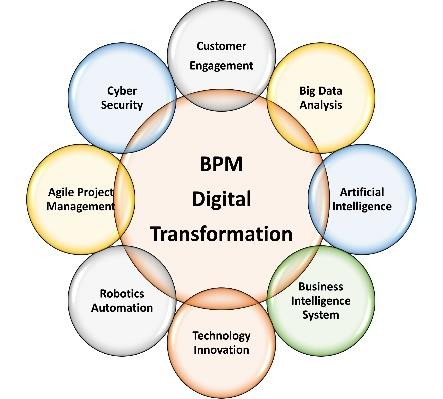
Some of core benefits of DTI in BPS includes the real-time analytics and decision-making, seamless integration of human and artificial intelligence, advanced customer engagement through personalised services, agile and resilient operations, and continuous innovation and knowledge sharing. The core characteristics that enable organisations to gain competitive advantage through digital BPM are graphically illustrated in Figure 1.
Emergent Development and Future Directions
Despite the momentum behind DTI in BPM, further extensive academic research and rigour industry investigation is necessary as recent studies have highlighted several areas where academic research remains underdeveloped:
– Identifying new roles and capabilities required for managing emerging digital technologies.
– Understanding interdependencies between technological innovation, organisational culture, and performance outcomes.
– Exploring how digital servitisation, offering services alongside products that
can be effectively managed through distribution channels and supply chains.
Mastering delivery network management remains critical, particularly as manufacturers and service providers transition to more digitally enhanced business models. This cultural shift requires employees at all levels to adopt a service-oriented mindset as an organisational challenge that cannot be overlooked.
Post-COVID Acceleration of DTI in BPM
Since 2019, and particularly in the post-COVID-19 era, the volume of research on DTI and BPM has grown substantially. This reflects the urgency of digital transformation as a strategic imperative. Between 2020 and 2025, studies have explored the impact of AI, robotics, knowledge management, Internet of Things (IoT), and AR on BPM.
However, the literature remains fragmented, with relatively few comprehensive, industry- wide analyses. This article contributes to the discussion by systematically reviewing recent advances in BIS, AI, and BDA as they relate to BPM. It highlights the trajectory of digital transformation across different industries, showing that the scope and scale of DTI adoption varies considerably.
For example, aviation, healthcare, and manufacturing are already digitally mature compared to banking, retail, and entertainment. Not every organisation needs to undergo full-scale digital transformation to remain profitable and competitive but those that fail to adapt risk falling behind as competitors leverage technology to improve customer experience and operational excellence.
BPM in the Digital Age
In conclusion, the integration of digital technologies into BPM represents more than just an operational upgrade, it is a strategic transformation that enables organisations to thrive in a complex, fast-changing environment. Technological innovation has reshaped BPM into a synergistic framework that combines human creativity with machine intelligence to deliver superior outcomes. Emerging technologies such as AI, AR, BDA, and BIS are not merely tools for automation; they are enablers of innovation, agility, and customer-centricity. By embracing digital transformation, businesses can create value in ways that were unimaginable just a decade ago.
Nevertheless, this transformation presents its own set of challenges: cultural resistance, skills gaps, data privacy concerns, and implementation complexities must all be managed effectively to unlock the full potential of DTI in BPM. The Industry 5.0 paradigm reinforces the need for human–machine collaboration, sustainability, and adaptability. As organisations navigate this landscape, BPM powered by technological innovation will remain at the heart of competitive strategy, driving continuous improvement, knowledge creation, and customer engagement.
This article lays the groundwork for future academic and professional research by highlighting the role of technological innovation in Business Process Management, Business Process Redesign, and Business Process Innovation. Organisations that succeed in aligning IT-driven operations with strategic goals will be best placed to lead in an increasingly digital and interconnected world. The era of static processes is over. The future belongs to adaptive, intelligent, and innovative BPM systems that learn, evolve, and create value continuously.
Dr Nasrullah K. Khilji
– Head of Information Systems & Knowledge Management Research Group
– Portfolio Leader for SCE Academic Partnership (UK & TNE)
– Associate Professor in Applied Project Management at School of Computing and Engineering, University of West London