
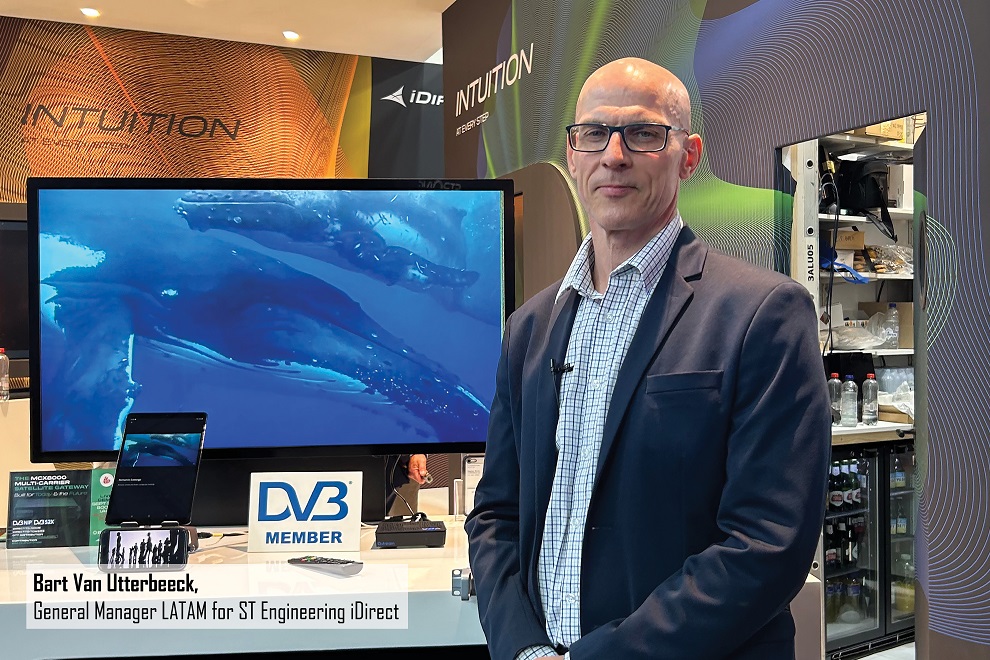

From powering in-flight entertainment to feeding 5G networks with broadcast content, satellite technology is no longer confined to traditional broadcasting. Instead, it’s evolving into an open, standardized ecosystem that supports diverse industries and markets. To get the latest insights into DVB-NIP, we sat down with Bart Van Utterbeeck, General Manager LATAM for ST Engineering iDirect to discuss how the company is driving this evolution — ensuring satellites remain at the core of tomorrow’s global communications fabric.
What is the DVB-NIP revolution?
DVB-NIP (Native IP) is a new broadcast standard developed by the DVB Project that allows satellite and terrestrial broadcast networks to deliver content directly in IP format — without the need to first convert IP streams into traditional transport streams (TS).
Traditionally, broadcasters used MPEG-TS (Transport Stream) for satellite and terrestrial broadcasting. But with today’s content and networks being IP-native — from streaming platforms to connected devices — DVB-NIP enables a seamless, end-to-end IP-based workflow.
In simple terms: DVB-NIP is about broadcasting content the way the internet already handles it — natively in IP packets.
Immediate Benefits for Broadcasters
- Direct IP Delivery – Content is distributed as IP streams, making it easier to integrate with OTT platforms, streaming services, and connected devices.
- Simplified Workflows – Eliminates the need for IP-to-TS conversion, reducing complexity and operational costs.
- Flexible Content Distribution – Broadcasters can deliver the same content simultaneously to traditional TV, mobile apps, and OTT platforms.
- Future-Proofing – Ensures compatibility with next-generation services, including hybrid 5G broadcast/multicast delivery.
Immediate Benefits for Network Operators
- Unified Infrastructure – Operators can serve both traditional broadcast customers and IP-native platforms using the same distribution channels.
- Scalability – Efficiently feeds terrestrial 5G towers, Wi-Fi hotspots, and edge caches with broadcast/multicast content.
- Cost Efficiency – Reduces bandwidth overhead by enabling multicast delivery of popular content (e.g., live events, software updates, entertainment).
- New Revenue Opportunities – Opens the door to partnerships with telecom operators and content platforms that are increasingly IP-focused.
DVB-NIP and Market Adoption
A central theme of the discussion was the role of DVB-NIP (Native IP) in media distribution. According to Bart, early adopters are already deploying DVB-NIP in commercial rollouts, from Peru to Europe, for broadcast and media applications.
He highlighted that broadcast and media delivery remain the first natural markets, with use cases ranging from in-flight entertainment to maritime video services. Moreover, DVB-NIP is expected to play a critical role as a feeder technology for 5G networks, supporting broadcast transmission from satellite uplinks to terrestrial towers.
“Any market that consumes media is a potential market,” Bart noted. “Broadcast environments, with their native content delivery models, are likely to lead adoption, but the applications extend far beyond traditional broadcasting.”
Cybersecurity and Regulatory Challenges
As satellite systems increasingly carry IP traffic, the twin issues of spectrum coordination and cybersecurity remain front and center.
On spectrum, Bart stressed the importance of regulatory alignment as new constellations emerge. On cybersecurity, he explained that ST Engineering iDirect applies a ‘security by design’ philosophy.
“Security is not an afterthought. We design products with security built in from the start, following guidelines such as the NIST cybersecurity framework,” he said.
Regulation, however, varies widely by region. Bart cited the Brazilian market, where Anatel mandates obligatory security tests before commercialization, as an example of growing oversight.
Seamless Interoperability Across Orbits
With the growing mix of LEO, MEO, and GEO networks, the challenge lies in enabling end-to-end service orchestration across systems that often belong to different operators. Bart emphasized that the key to this lies in adhering to open standards.
“Customers want a unified service end-to-end. To achieve that, you must ensure orchestration protocols and automated service setup work seamlessly across networks,” he explained. “That means designing subsystems as networks of networks, where interfaces interconnect without friction.”
By supporting standards at the transmission layer and aligning with emerging frameworks such as 3GPP for 5G NTN, ST Engineering iDirect is ensuring interoperability across orbital layers and future-proofing services.
The Next Leap: 5G NTN
Looking ahead, Bart believes the industry’s next major leap will be 5G Non-Terrestrial Networks (NTN). While efficiency and throughput depend on satellite power and link budgets, the real breakthrough lies in market reach and ecosystem integration.
“5G NTN will allow satellite to blend seamlessly into existing telecom environments,” Bart explained. “It also opens the door to a wider variety of terminal vendors thanks to open standard protocols, which expands accessibility and scalability.”
Editor’s comments:
ST Engineering iDirect’s vision reflects the broader trajectory of the satellite industry: from closed, proprietary systems to an open, standardized, and secure ecosystem. As DVB-NIP gains traction and 5G NTN approaches commercial reality, the company is positioning itself at the intersection of media distribution, telco integration, and cybersecurity assurance.
At a time when the world increasingly demands seamless connectivity, ST Engineering iDirect is making sure satellite remains not just relevant, but essential, to the global communications fabric.
Stay tuned for another feature on the latest and greatest in 5G NTN!