

Muhammad Hassan Latif
As global data traffic continues to surge and digital infrastructure becomes a central pillar of economic strategy, the Middle East is steadily redefining its role in the global connectivity map. At the centre of this shift is Capacity Middle East 2026, returning to Dubai’s Grand Hyatt Conference & Exhibition Centre from 10–12 February, with a dedicated pre-event focus on Iraq taking place on 9 February.
Long regarded as the region’s flagship connectivity gathering, Capacity Middle East has matured into a barometer for where the wholesale telecoms and broader digital infrastructure market is heading. What began as a carrier-centric meeting has evolved into a comprehensive platform reflecting the convergence of networks, cloud, content, data centres, and digital services — a convergence now shaping investment and policy decisions across the Middle East, Africa and beyond.
With over 3,500 senior industry leaders expected from more than 90 countries, and participation from 1,000+ companies, the 2026 edition is positioned not merely as a networking forum, but as a strategic checkpoint for an industry navigating rapid expansion, intensifying competition and rising capital deployment.
The Middle East’s Expanding Digital Role
The Middle East’s connectivity narrative has changed significantly in recent years. Once viewed primarily as a transit region between Asia, Europe and Africa, it is now emerging as a destination market in its own right — driven by national digital transformation strategies, hyperscale cloud expansion, data localisation requirements, and increasing demand for low-latency services.
Governments across the Gulf and wider MENA region are investing heavily in fibre networks, subsea routes, IXPs and data centres, while positioning digital infrastructure as a foundation for AI, smart cities, fintech and industrial digitisation. This has created a fertile environment for both regional and international investors, as well as infrastructure providers seeking long-term growth.
Against this backdrop, Capacity Middle East plays a dual role: facilitating commercial engagement while also shaping industry dialogue around sustainability, resilience and regional cooperation. Many of the partnerships and network routes now underpinning the region’s digital ecosystem can trace their origins back to discussions held at the event.
An Agenda Anchored in Market Reality
The 2026 conference agenda reflects an industry that has moved beyond early-stage experimentation and is now focused on execution, optimisation and scale. Sessions are structured around practical considerations rather than theoretical forecasts, addressing the commercial and operational realities facing operators, infrastructure providers and digital platforms.
Central to the discussions is the ongoing digital infrastructure investment cycle unfolding across the Middle East. Panels will examine how capital is being allocated across fibre, subsea, data centres and cloud interconnection, and how investors are assessing risk and return in a market characterised by rapid build-out.
Another key focus is the evolution of network operations. Automation, programmability and standardisation are increasingly viewed as prerequisites for competitiveness rather than optional enhancements. As traffic volumes rise and service expectations tighten, operators are under pressure to deploy smarter, more agile networks that can support enterprise, cloud and content customers efficiently.
The agenda also maintains a strong emphasis on market inclusivity, exploring how connectivity strategies can address disparities between high-density urban hubs and underserved or emerging markets. This includes discussions on alternative business models, partnerships and technologies capable of extending coverage while remaining commercially viable.
Agenda Highlights
- Digital infrastructure investment trends and capital flows in the Middle East
- Network automation, APIs and programmability as enablers of scale
- Carrier, cloud and data centre convergence
- Resilience, redundancy and alternative routing strategies
- The future of messaging, eSIMs and digital enablement services
Together, these themes underscore a sector focused on long-term value creation rather than short-term expansion alone.
Capacity Iraq Connect: A Market Moves into Focus
A notable feature of the 2026 programme is Capacity Iraq Connect, a dedicated pre-event forum designed to examine Iraq’s re-emergence on the regional connectivity landscape. Taking place on 9 February, the initiative reflects growing industry recognition of Iraq’s strategic and commercial potential.
Iraq occupies a critical geographic position linking the Gulf, Asia and Europe, offering the possibility of alternative and diversified fibre routes at a time when network resilience has become a strategic priority. At the same time, the country’s domestic market presents significant demand for improved connectivity, data services and digital infrastructure.
Capacity Iraq Connect provides a focused environment for dialogue around national backbone development, cross-border connectivity, policy frameworks and the role of internet exchanges in local traffic localisation. For operators, investors and technology partners, the forum offers early insight into a market that is moving from recovery towards structured digital growth.
Industry Voices with Operational Perspective
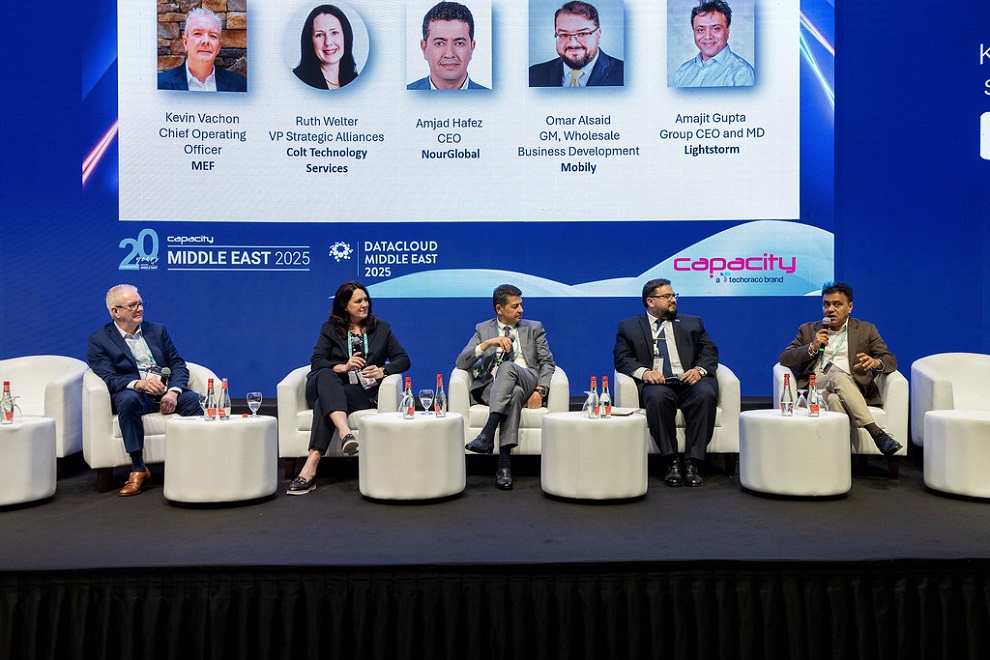
Capacity Middle East’s speaker lineup continues to draw from the upper tiers of the industry, bringing together executives from regional and global carriers, hyperscale cloud providers, data centre operators, satellite companies and regulatory institutions.
What distinguishes the event is the operational relevance of its speakers. These are leaders actively deploying infrastructure, managing networks and shaping commercial strategies across diverse markets. Their contributions tend to focus less on aspirational narratives and more on what is proving effective — and what is not — in today’s competitive environment.
For attendees, these sessions provide a valuable opportunity to benchmark strategies, understand peer perspectives and assess how market leaders are responding to shared challenges such as rising costs, evolving customer demands and regulatory complexity.
Beyond the Conference Programme
While the conference sessions remain a central pillar, Capacity Middle East’s influence extends well beyond formal panels. The event has long been recognised for the quality of its networking environment, which is carefully designed to encourage both structured meetings and spontaneous interaction.
The exhibition floor serves as a focal point for engagement, showcasing developments across subsea systems, terrestrial networks, cloud connectivity, satellite services and digital platforms. For many participants, it is where initial conversations quickly evolve into commercial discussions.
Dedicated spaces such as the VIP Lounge and Networking Oasis provide a more discreet setting for senior-level engagement, enabling deeper discussions around partnership, investment and market entry strategies. These areas have become integral to the event’s appeal, particularly for executives managing regional or global portfolios.
Social and cultural experiences — including welcome receptions and evening gatherings — add another layer, reinforcing relationship-building in an environment that blends professional focus with regional character.
Why Capacity Middle East Remains a Strategic Fixture
As global connectivity becomes more intertwined with geopolitics, economic resilience and technological sovereignty, the importance of trusted industry forums continues to grow. Capacity Middle East has retained its relevance by evolving alongside the market it serves, broadening its scope while maintaining a clear focus on connectivity fundamentals.
For the Middle East, the event arrives at a pivotal moment. Infrastructure is scaling rapidly, competition is intensifying, and the region’s digital ambitions are becoming increasingly interconnected with global networks. Capacity Middle East offers a platform where these dynamics can be examined collectively, informed by real-world experience rather than speculation.
For stakeholders across telecoms, cloud, data centres and digital services, Capacity Middle East remains not just an annual gathering, but a strategic touchpoint — one that continues to influence how the region connects, grows and competes in the global digital economy.