
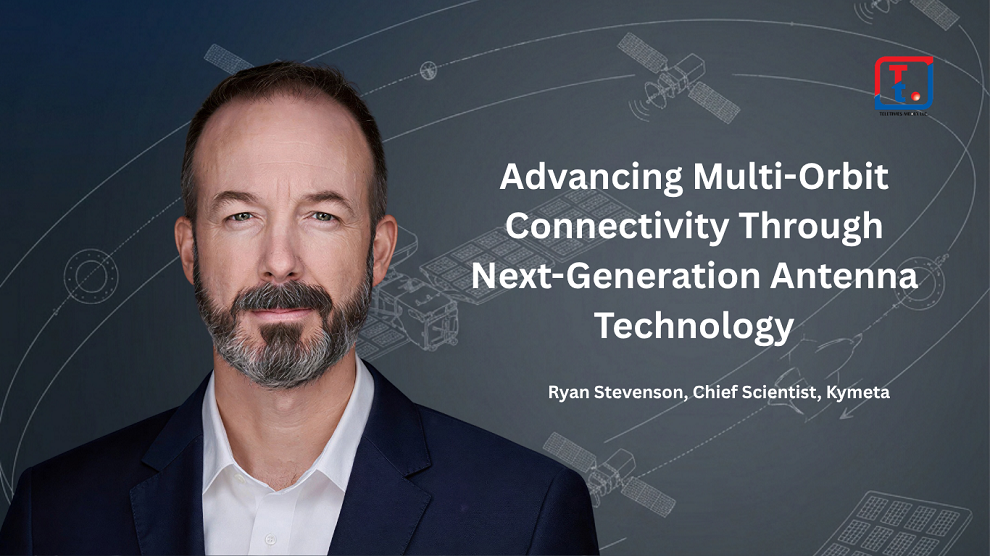

Ryan Stevenson, Chief Scientist, Kymeta, discusses the evolution of electronically steered antennas, multi-orbit connectivity, and the technologies shaping the future of satellite communications.
Gulraiz: Kymeta has recently attracted significant attention for its growing role in mobility connectivity, particularly in the rail sector. How do you see this market evolving, and what role will solutions such as the Kestrel U5 play in addressing emerging customer requirements?
Ryan Stevenson: One of the key applications for our Kestrel U5 terminal is high-speed rail connectivity. This is a particularly demanding environment, with stringent operational and environmental requirements, and it remains a segment that has historically been underserved.
We are excited about the potential of this next-generation product to address those needs. The Kestrel U5 represents what we consider the third generation of Kymeta technology and marks a significant step forward in our technology roadmap. It incorporates major advancements over previous generations while delivering a smaller, lighter and lower-power solution. Overall, it represents a substantial evolution in both performance and design.
GK: Considering Kymeta’s extensive experience in electronically steered antennas, what advantages does that bring in today’s market?
RS: Mobility applications benefit greatly from electronic beam steering. Traditional mechanically steered parabolic antennas can be challenging to deploy effectively in highly dynamic environments such as trains, vehicles and other mobile platforms.
“The combination of electronic steering, multi-orbit capability and a favourable SWaP profile creates a compelling solution for the next generation of mobility-focused connectivity applications.”
Kymeta’s electronically steered antenna technology is designed to provide efficient operation while supporting connectivity across multiple satellite orbits. For applications that require resilient communications, seamless mobility and the ability to operate across both LEO and GEO networks, power efficiency becomes especially important.
The combination of electronic steering, multi-orbit capability and a favourable SWaP profile—size, weight and power—creates a compelling solution for mobility-focused applications.
GK: With spectrum efficiency and power optimisation becoming major priorities across the industry, how does this benefit Kymeta and its customers?
RS: Multi-orbit interoperability enables more intelligent and efficient use of available network resources. As the industry progresses from 5G toward 6G, there is increasing discussion around AI-assisted network management.
Future networks may be able to dynamically direct user terminals to operate on different satellite constellations or orbital layers depending on traffic demand, network conditions and spectrum utilisation. Flexible terminals capable of operating across multiple orbits and frequency bands can play an important role in that environment.
Looking ahead, our planned Ku- and Ka-band developments are intended to further expand that flexibility by enabling more dynamic operation across networks, frequency bands and orbital architectures.
GK: Do you see examples of AI already being deployed in satellite network management?
RS: Yes, there are companies actively developing AI-driven network management platforms. One example that comes to mind is Elyria, although there are others as well. We expect the use of AI in network optimisation and resource management to continue growing as the industry moves toward 6G architectures.
“As the industry moves from 5G toward 6G, flexible terminals capable of operating across multiple orbits and frequency bands will play an increasingly important role in network optimisation and resilience.”
GK: Given your background, how do you view the role of materials science and metamaterials in the satellite communications industry today?
RS: Materials science remains extremely important to our technology development. Kymeta has been a pioneer in the commercialisation of metamaterial-based satellite antenna technology, so advancements in this area are highly relevant to us.
Across the broader industry, manufacturers continue to benefit from advances in printed circuit board manufacturing, semiconductor technologies and assembly techniques. These innovations contribute to improved performance, greater integration and lower manufacturing costs.
While different antenna technologies leverage different underlying components and processes, advances in materials science continue to drive progress across the entire satellite communications ecosystem.
GK: What recent innovation has had the greatest impact on Kymeta’s latest products?
RS: For the Kestrel U5, one of the most significant developments has been the evolution of advanced PCB manufacturing techniques, particularly additive manufacturing processes.
Traditional subtractive manufacturing removes material from a copper layer to create the desired circuit pattern. Newer additive techniques allow for much finer feature definition and higher-density integration. This capability enables more sophisticated designs and improved performance.
These manufacturing advancements have played an important role in enabling the architecture and integration levels required for products such as the Kestrel U5.
GK: How is Kymeta supporting operators as they move toward 5G, 6G and increasingly integrated terrestrial-satellite networks?
RS: Kymeta has been actively involved in the development of non-terrestrial network (NTN) technologies. We have participated in industry initiatives exploring how emerging 5G NTN standards can be supported over satellite networks in mobile environments.
Today, we continue to monitor developments from organisations such as MediaTek, Eutelsat and others that are working to advance NTN capabilities. Beyond traditional satellite backhaul, the industry is increasingly focused on more native integration between cellular and satellite networks.
As standards mature, we expect to see greater adoption of native 5G NTN implementations capable of delivering higher-performance satellite connectivity directly within broader telecommunications ecosystems.
GK: From a geographical perspective, how important are the Middle East and South Asian markets to Kymeta?
RS: They are very important regions for us.
These markets often present challenging environmental conditions, including high temperatures and demanding operating environments. Such conditions place significant requirements on communications equipment and make reliability a critical consideration.
As a result, we see considerable opportunity for advanced satellite connectivity solutions across both regions.
GK: The ruggedness and durability of equipment must play a key role in those markets.
RS: Absolutely. Thermal performance is particularly important.
Many electronically steered antenna technologies generate significant heat during operation. When combined with high ambient temperatures and solar loading, thermal management can become a major challenge.
One of the distinguishing characteristics of the Kestrel U5 is its passively cooled architecture. This contributes to operational efficiency and supports reliable performance in demanding environmental conditions.
GK: What are the most important technology developments currently shaping Kymeta’s roadmap?
RS: The Kestrel U5 represents an important milestone in our technology evolution and reflects our continued focus on mobility and multi-orbit connectivity.
“The long-term goal is to enable simultaneous operation across both Ku-band and Ka-band networks, providing customers with greater flexibility in increasingly complex multi-network environments.”
In parallel, we are advancing our Ku- and Ka-band technology roadmap. The objective is to build on our existing capabilities by integrating both Ku-band and Ka-band receive and transmit functionality into a shared antenna aperture.
Development work is ongoing, and we continue to refine the product definition and specifications. The long-term goal is to provide simultaneous operation across both Ku-band and Ka-band networks, enabling greater flexibility for customers operating in increasingly complex multi-network environments.