
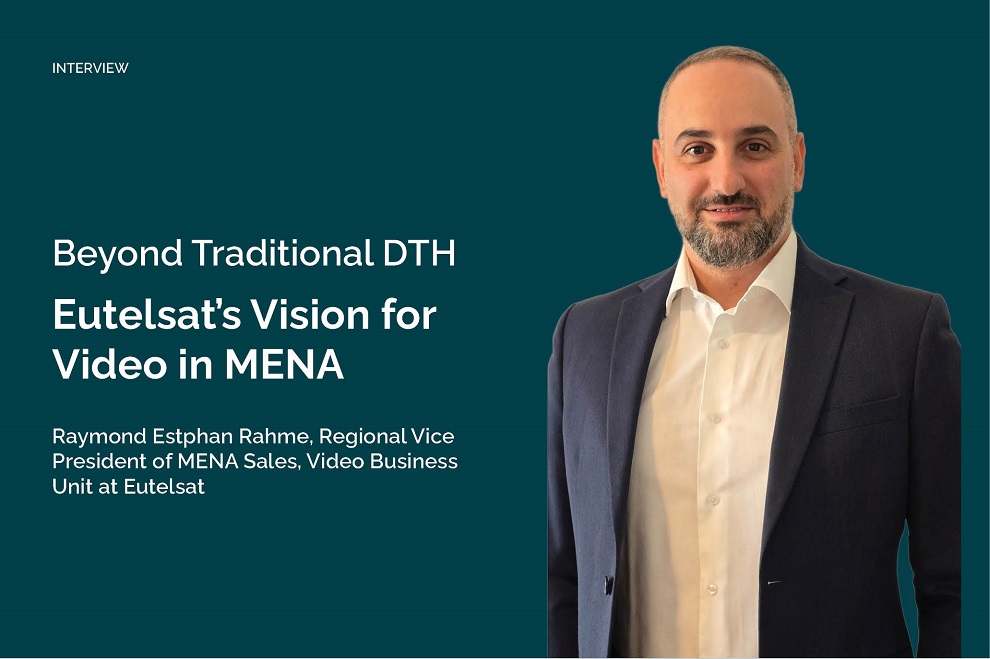

The video landscape across the Middle East and North Africa is evolving rapidly, creating new opportunities for broadcasters to expand reach, improve the viewer experience and generate additional revenues. With satellite at the heart of the region’s distribution ecosystem, Raymond Estphan Rahme, Regional Vice President of MENA Sales, Video Business Unit at Eutelsat, discusses the trends shaping the market and the technologies influencing the next phase of video distribution.
Interview: Gulraiz Khalid
Teletimes: How is the video broadcasting market evolving across MENA, and what trends are having the greatest impact on the industry?
Raymond Estphan Rahme: One of the major trends we are seeing is a greater need to reach much larger populations. In the current regional context, resilience and service continuity have also become essential. The ability to distribute content effectively, in consistently high quality, to very large audiences, wherever they are located, remains extremely important. This is where satellite continues to demonstrate its unique strengths, combining extensive coverage with highly reliable, one-to-many distribution that does not depend on the number of people watching.
Sports content is a particularly strong example of this. We are seeing strong momentum around sports content, supported by government-led initiatives in markets such as Saudi Arabia. As audiences for premium sporting events grow, so does the challenge of delivering a high-quality live experience to millions of viewers simultaneously. Satellite is ideally suited to this environment, providing consistent quality and broad coverage, even in areas where fixed or mobile connectivity is limited.
At the same time, the industry is looking beyond reach alone and increasingly focusing on how to generate more value from content and audiences. Broadcasters and other media players are looking at how they can strengthen engagement, better understand their viewers and open up new monetisation opportunities. This is where Eutelsat’s new video solutions can play an important role, combining the scale and reliability of satellite distribution with new capabilities that help broadcasters create greater value.
Teletimes: As streaming continues to grow, how is satellite’s role evolving within the broader video distribution ecosystem?
Rahme: Satellite remains at the heart of the broader video ecosystem. Despite the growth of streaming, it continues to be the main consumption model for viewers across the region. Our 7/8° West video neighbourhood alone reaches 70 million homes in the MENA region, with around 1,000 channels.
The fundamental advantages of satellite remain highly relevant. It provides wide and resilient coverage, enabling broadcasters to reach audiences across large geographic areas.
“Satellite remains at the heart of the broader video ecosystem. It is still the main consumption model of the viewer in the region.”
This is particularly important in countries where infrastructure is not very developed. In these markets, satellite continues to provide the coverage and reach needed to deliver video content effectively to viewers.
Teletimes: Which markets and customer segments offer the strongest growth opportunities for Eutelsat’s video business in MENA?
Rahme: I would put sports at the top of the list. There is significant interest around sports content across the region, making it an important segment for the video market with growing audience demand creating significant opportunities for video distribution.
News is another key segment. Given the dynamics of the region, demand for immediate, reliable access to news content remains consistently strong, reinforcing the importance of robust, wide-reaching distribution.
General entertainment also continues to play a major role. Turkey and Egypt, in particular, are two huge content hubs in the region with a strong and continuous pipeline of new programming. This creates an ongoing need to distribute content efficiently, both within individual markets and across the wider MENA video ecosystem.
Teletimes: How is Eutelsat leveraging new technologies and hybrid distribution models to enhance its video offering?
Rahme: We are building on the strengths of traditional satellite by adding new technologies that bring greater flexibility, engagement and monetisation opportunities to our customers.
DVB-NIP is a great example. Delivering OTT over satellite, it effectively brings together the best of two worlds, combining the reach and efficiency of DTH with the flexibility and user experience of OTT distribution.
With Sat.tv we are enriching the traditional DTH experience, making content easier to discover, giving viewers access to more information and creating a more engaging user experience.
“Viewership measurement and targeted advertising over satellite are now possible which is directly facilitating the capability to generate more revenues from advertising.”
We are also introducing audience measurement and targeted advertising over satellite. These are particularly relevant, giving broadcasters greater insight into their audiences and new ways to generate more value and revenues from advertising.
FAST is another exciting opportunity. Bringing OTT content onto satellite, helps expand the reach of that content while also creating additional opportunities to generate advertising revenues.
Another important development is Video Contribution over LEO, through Eutelsat’s OneWeb constellation. This offers a new way to backhaul content, supporting fully IP native workflows with low latency, easy-to-deploy solutions.
Together, these technologies allow us to combine the scale and reliability of satellite with the flexibility, intelligence and monetisation potential of IP, creating a richer and more powerful video ecosystem.
Teletimes: Looking ahead, what are Eutelsat’s key priorities for strengthening its video business and partnerships across the MENA region?
Rahme: Our priority is to build on our leading position in MENA, maintaining our premium reach, while continuing to bring more value to our customers and partners. This includes enhancing our core video offering with new capabilities such as electronic programme guides, audience measurement and targeted advertising, helping broadcasters better understand and engage their audiences and unlock new revenue opportunities.
At the same time, we will continue to accelerate the adoption of our new solutions that complement traditional satellite distribution and respond to the evolving needs of the market.
Importantly, this is not only about providing new capabilities directly to consumers. We want to bring value to other players across the MENA video ecosystem. By combining our existing reach with these newer technologies and services, we can continue to evolve our video offering in line with the changing requirements of the regional market.